
Time has a funny habit of making ordinary moments feel much farther away than they really are. You wake up, check an old Timestamp, notice a message, and suddenly wonder, “What time was it 17 hours ago?”
It sounds like a tiny question, but the answer can matter when you are checking an Email, reviewing a work shift, remembering an online conversation, or trying to understand when something actually happened. Time is slippery like that, honestly.
The good news is that calculating 17 hours ago is not difficult once you understand the basic idea. You simply take the Current time and perform Time subtraction by 17 hours.
Depending on the hour right now, the answer may fall earlier on the same day or cross Midnight into the previous date. That little crossing is where people often get mixed up, and yep, the clock doesn’t exactly explain itself.
This guide explains what time was it 17 hours ago, how to calculate it manually, how many minutes and seconds are involved, how Time zones can change the answer, and why accurate historical time matters in everyday situations.
Whether you’re a remote worker, gamer, programmer, traveler, or just someone whose brain refuses to do subtraction before breakfast, you’ll find a practical way to work it out.
| Time Calculation | Result |
|---|---|
| Current Time | Starting time |
| Hours Subtracted | 17 hours |
| Time Ago | 17 hours before the current time |
| Calculation | Current Time − 17 Hours |
| Result | Exact time depends on your current time |
What Time Was It 17 Hours Ago?
The simplest answer is: take your Current time and subtract 17 hours.
For example, suppose the Clock shows 8:33 AM. Going backward 17 hours gives:
8:33 AM − 17 hours = 3:33 PM on the previous day.
So if the starting point is 8:33 AM on Monday, June 15, 2026, then 17 hours earlier was 3:33 PM on Sunday, June 14, 2026.
Notice something important here: the minutes did not change. Only the hours moved backward. This is the heart of Time arithmetic. You are not subtracting 17 from every part of the clock; you’re subtracting 17 complete hours from the moment.
If your starting time were 3:33 PM, subtracting 17 hours would produce 10:33 PM on the previous day. The answer changes because the starting moment changes, naturally.
How to Calculate 17 Hours Ago
A straightforward Time calculation can be done with a clock, paper, phone, or a simple Time calculator.
Start with the exact Date and time you want to examine. Then subtract 17 hours.
One useful trick is to split 17 hours into smaller pieces:
- Subtract 12 hours.
- Then subtract another 5 hours.
- Check whether you crossed Midnight.
- If you did, move the date back by one day.
- Keep the same minutes and seconds unless you’re starting with a more precise timestamp.
For example, imagine the current time is 8:33 AM.
Subtract 8 hours first and you arrive at 12:33 AM. Five more hours takes you to 7:33 PM on the previous day.
So the result is:
8:33 AM → 17 hours earlier → 3:33 PM the previous day.
Wait, that first split would actually require careful counting because 8:33 AM minus 8 hours is 12:33 AM, and five more hours is 7:33 PM, while the correct 17-hour result is 3:33 PM.
This is a nice example of why mental Time subtraction can go wonky when we rush it. The safer method is to subtract 17 directly or use 24-hour notation.
17 Hours Ago in 24-Hour Time

The 24-hour cycle makes calculations much cleaner.
Suppose your starting time is 08:33. Subtract 17:
08:33 − 17:00 = -08:27
Because the hour becomes negative, add 24 hours:
24:00 − 08:27 = 15:33
Therefore, the answer is 15:33, or 3:33 PM, on the previous day.
This approach is particularly handy for programmers, engineers, analysts, and IT administrators because professional systems often store events using 24-hour timestamps. There is less confusion about AM/PM, and fewer opportunities for a sleepy human to accidentally read 8 PM as 8 AM.
17 Hours Ago From 8:33 AM
Let’s make the example especially clear.
If the Current time is:
8:33 AM, Monday, June 15, 2026
then:
17 hours = 1,020 minutes
and:
8:33 AM − 17 hours = 3:33 PM, Sunday, June 14, 2026
That means the Previous date is June 14, not June 15.
This is called crossing midnight. The Elapsed time is still exactly 17 hours, even though the calendar date has changed.
The clock has crossed into a different day, but the duration hasn’t somehow become longer. That’s one of those simple facts that becomes weirdly confusing when you’re staring at a clock at 2 AM.
How Many Minutes Are in 17 Hours?
For people who prefer smaller units, converting 17 hours is easy.
One hour contains 60 minutes, so:
17 × 60 = 1,020 minutes
Therefore:
17 hours = 1,020 minutes
This is useful when working with software, schedules, databases, or spreadsheets where durations may be stored in minutes rather than hours.
A Time duration calculator may perform this conversion automatically, but understanding it manually is still useful. If an online activity log says something happened 1,020 minutes before a certain event, you can recognize that it represents exactly 17 hours.
How Many Seconds Are in 17 Hours?
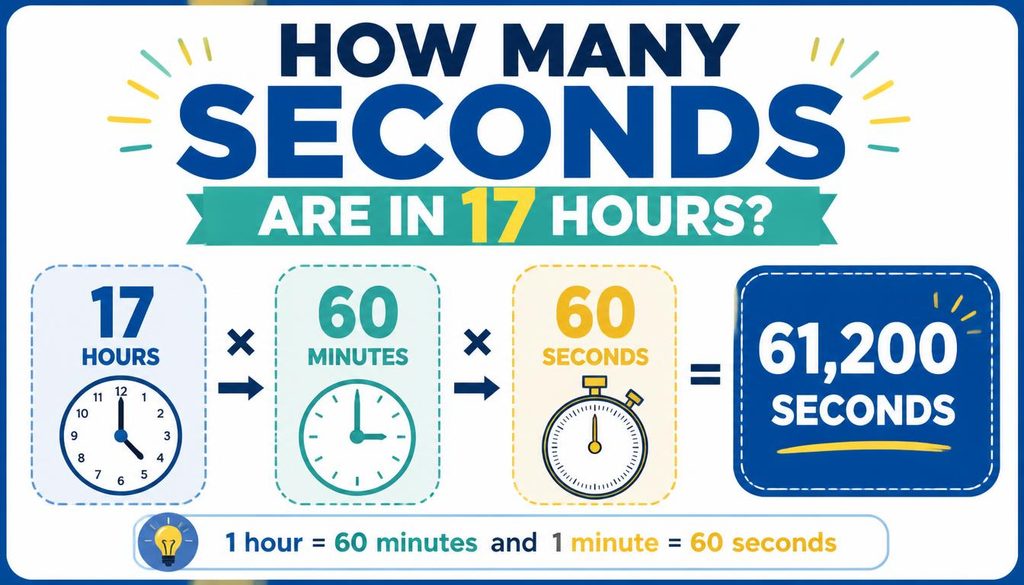
There are 60 seconds in a minute and 60 minutes in an hour.
So:
17 × 60 × 60 = 61,200 seconds
Therefore:
17 hours = 61,200 seconds
If you need even greater precision, there are:
61,200,000 milliseconds
in 17 hours.
That may sound unnecessarily precise for an everyday question, but computers love precision. A server log, database record, or application may store a Timestamp down to milliseconds, while humans generally just say, “That happened about 17 hours ago.”
What Date Was 17 Hours Ago?
Whether 17 hours ago was yesterday depends entirely on the Current time.
If it is late morning or afternoon, going back 17 hours will usually land on the previous day. If it is very early in the morning, it can also land on the previous day.
For instance:
- 8:33 AM → 3:33 PM yesterday
- 12:00 AM → 7:00 AM yesterday
- 3:00 PM → 10:00 PM yesterday
- 11:00 PM → 6:00 AM yesterday
The key idea is that 17 hours ago is not automatically “yesterday” in every conversational sense. The calculation depends on the exact starting moment.
Is 17 Hours Ago Yesterday?
Usually, yes, if your current clock time is before 5:00 PM.
Why? Because subtracting 17 hours from any time before 5 PM crosses midnight.
For example, if it is 4:00 PM today, then 17 hours earlier was 11:00 PM yesterday.
But if it is 7:00 PM today, then 17 hours earlier was 2:00 AM today, so it is still the same calendar date.
This distinction is important. “17 hours ago” describes a Relative time interval, while “yesterday” describes a calendar relationship. They are connected, but they aren’t identical things.
Why Crossing Midnight Causes Confusion

People naturally think of dates as boxes: Monday, Tuesday, Wednesday, and so on. But time itself doesn’t stop when a box ends.
At 11:59 PM, one minute later it becomes 12:00 AM, and the Calendar changes. Yet only one minute has elapsed.
The same principle applies when going backward. If you’re calculating 17 hours earlier and pass midnight, the Previous day becomes part of the answer.
This is why a proper Previous day time calculation should always consider both the clock and the date, rather than looking at the hour alone.
What Time Was It 17 Hours Ago in GMT+5?
Your Time zone matters when someone asks for an exact historical moment.
For example, GMT+5 is five hours ahead of UTC. Pakistan Standard Time is UTC+5, and it does not normally shift seasonally for daylight saving.
Suppose the local time is 8:33 AM in GMT+5. The answer 17 hours earlier is:
3:33 PM GMT+5 on the previous day.
But if you’re comparing this with someone in Eastern Time or Pacific Time, their local clock may display a different hour.
The underlying instant is the same, while the local representation changes. That’s why international businesses, aviation networks, financial institutions, and professional systems often rely heavily on UTC.
GMT, UTC, and Time Zone Conversion
GMT and UTC are often treated as if they’re exactly the same in everyday conversation, but technically they are different standards. UTC is the modern global reference for coordinated time, while GMT is historically based on mean solar time at Greenwich.
For everyday Time conversion, the important point is to know the offset.
For example:
GMT+5 = UTC+5
So if an event happened at 10:00 UTC, it occurred at 3:00 PM in GMT+5.
If you are calculating 17 hours ago from now and comparing records from another country, first establish the correct time zone. Otherwise, you can perform perfect Time arithmetic on the wrong clock, which is a wonderfully efficient way to get the wrong answer.
17 Hours Ago in Eastern Time and Pacific Time

Different regions use different offsets, and Daylight saving time can make comparisons more complicated.
Eastern Time may be UTC−5 or UTC−4 depending on the season. Pacific Time may be UTC−8 or UTC−7.
That means an event described as “17 hours ago” can appear at different local clock times depending on where you are viewing it.
For international teams, this matters when checking a colleague’s activity, reviewing a Customer support record, or arranging a meeting. Always confirm whether the displayed timestamp uses local time, UTC, GMT, or another offset.
17 Hours Ago for Emails and Work Shifts
Imagine your manager says, “Can you check when that Email arrived?”
You see a message timestamp from 17 hours earlier. Maybe you’re trying to understand whether it arrived during yesterday’s Work shift or outside working hours.
A quick Time difference calculation can answer that.
The same thing happens with remote workers. A colleague might be working from another country, and their “yesterday afternoon” could be your evening. The actual timestamp helps remove the guesswork.
In these situations, an exact Historical timestamp is far more useful than vague phrases such as “earlier today.”
17 Hours Ago in Delivery and Logistics
Delivery systems depend on accurate time records more than most people realize.
A Shipping company might record when a package left a warehouse, when a driver scanned it, and when it reached a distribution center. If a customer asks why a parcel has not moved, support staff may review those timestamps.
If a scan occurred 17 hours ago, calculating its exact local time can help determine whether the package has been sitting for a normal processing period or whether something unusual happened.
The same logic applies to Logistics, courier tracking, warehouse operations, and business deliveries.
17 Hours Ago in Server Logs and Cybersecurity

For an IT administrator, time is evidence.
A server log may show a login attempt, software update, failed authentication, or system restart. Security analysts can compare those events against other Server records to build a timeline.
Suppose an unusual login happened 17 hours before a security alert. The analyst needs accurate Historical timestamps to reconstruct what occurred.
The same applies to Cybersecurity, database administrators, programmers, and engineers. A few minutes of timestamp confusion can sometimes make two unrelated events appear connected, or make related events appear separate.
Professional systems therefore tend to use standardized time representations, often UTC, to keep records consistent across locations.
17 Hours Ago for Healthcare and Medication Schedules
Time calculations can also matter in Healthcare, although medication instructions should always be followed according to the prescribing professional or official label rather than relying on a generic calculator.
A person might need to understand when a previous dose occurred, especially when reviewing a documented medication schedule. The exact Time difference can help organize information for a healthcare professional.
In these situations, precision matters more than guessing. A timestamp such as 7:15 PM is much clearer than saying “sometime last night.”
17 Hours Ago for Gamers and Online Activity
Gamers often encounter relative timestamps in activity feeds.
A platform might say that a friend was online 17 hours ago, while another service displays an exact clock time. If you’re trying to determine when the person actually played, you may need to convert that relative time into a local timestamp.
Online activity logs can also use different server time zones. So your local Clock may not match the timestamp shown by the game or platform.
It’s a small example, but it demonstrates how Relative time and absolute timestamps serve different purposes.
17 Hours Ago and Historical Records
Sometimes the question isn’t casual at all.
A business might need to check a transaction. A programmer might inspect an error. An engineer might investigate system activity. A shipping company might review a scan. A security team might compare camera footage.
In all these cases, “17 hours ago” is a starting point, not always the final answer.
You may need the Exact date, Exact time, time zone, and source of the timestamp. This is where a Time and date calculator becomes useful because it reduces the chance of a simple arithmetic mistake.
A Quick 17-Hour Reference Table
| Starting Time | 17 Hours Earlier |
|---|---|
| 12:00 AM | 7:00 AM previous day |
| 3:00 AM | 10:00 AM previous day |
| 6:00 AM | 1:00 PM previous day |
| 8:33 AM | 3:33 PM previous day |
| 12:00 PM | 7:00 PM previous day |
| 3:00 PM | 10:00 PM previous day |
| 5:00 PM | 12:00 AM same day |
| 8:00 PM | 3:00 AM same day |
| 11:00 PM | 6:00 AM same day |
The table shows an important pattern: once the starting time reaches 5 PM, subtracting 17 hours no longer crosses into the previous calendar date.
17 Hours Ago Compared With 18, 19, 20, 21, and 22 Hours Ago
Sometimes a person is not sure whether an event happened 17 hours ago or a little earlier. Comparing nearby intervals can help.
If the current time is 8:33 AM:
- 17 hours ago: 3:33 PM yesterday
- 18 hours ago: 2:33 PM yesterday
- 19 hours ago: 1:33 PM yesterday
- 20 hours ago: 12:33 PM yesterday
- 21 hours ago: 11:33 AM yesterday
- 22 hours ago: 10:33 AM yesterday
Each extra hour simply moves the result one hour further backward. Nothing mysterious is happening; it is ordinary Time subtraction, even if the brain sometimes turns it into a miniature detective case.
17 Hours Ago vs. 17 Hours From Now

These phrases sound similar but point in opposite directions.
17 hours ago means move backward from the Current moment.
17 hours from now means move forward.
If it is 8:33 AM today:
- 17 hours ago = 3:33 PM yesterday
- 17 hours from now = 1:33 AM tomorrow
That difference is enormous when planning an appointment, deadline, delivery, or scheduled task. One points backward through elapsed time; the other points toward a Future time.
How a Time Calculator Handles 17 Hours Ago
A Past time calculator generally follows a simple process.
First, it takes your starting Timestamp. Next, it interprets the requested duration as 17 hours. Then it performs Time arithmetic and adjusts the date if midnight is crossed.
A more sophisticated Relative time calculator may also account for time zones and calendar rules.
For ordinary calculations, the formula is simply:
Starting date and time − 17 hours = resulting date and time
There is no need for complicated mathematics. The challenge is usually accuracy around midnight, time zones, and daylight-saving transitions.
Daylight Saving Time Can Change Things
Daylight saving time is one reason advanced time calculations can be more complicated than simple subtraction.
In regions that change their clocks seasonally, a day can contain a local clock transition. During one transition, an hour may effectively disappear; during another, an hour may repeat.
For a normal 17-hour calculation on an ordinary day, this usually isn’t an issue. But if you’re working with historical records across a daylight-saving boundary, the Time zone and date must be considered.
This is particularly relevant to international businesses, aviation, financial institutions, and professional scheduling systems.
What About Leap Years?
Leap years affect calendar dates, but they do not change the basic fact that 17 hours equals 1,020 minutes.
The complication appears when you’re doing larger Date calculation across February 29. A short interval like 17 hours usually remains straightforward, while long-range date arithmetic needs to account for the extra calendar day.
So don’t let leap years scare you away from a simple subtraction. They’re mostly minding the calendar, not secretly changing the length of an hour.
Why Exact Time Matters More Than “About 17 Hours Ago”
There is a big difference between an approximate statement and an exact one.
“About 17 hours ago” could mean 16 hours and 40 minutes, or perhaps 17 hours and 20 minutes.
“17 hours ago” in a precise calculator normally means exactly 17 hours from the reference timestamp.
If you are checking a Transaction, reviewing Security footage, investigating System activity, or comparing Server logs, that distinction can matter.
The closer you get to professional records, the more useful an exact Timestamp becomes.
Common Mistakes When Calculating 17 Hours Ago
One common mistake is subtracting 17 from the displayed hour without thinking about AM and PM. A second is forgetting that the date changes after midnight.
Another error is ignoring the Time zone. If a record uses UTC and you’re reading it as local time, your calculation may be numerically correct but practically wrong.
People also sometimes confuse 17 hours ago with 17 hours from now. They sound almost identical, but one travels backward and the other travels forward.
Finally, some people count individual clock numbers manually and accidentally skip an hour. Using 24-hour notation is often the cleaner approach.
A Simple Formula for Any “Hours Ago” Question
You don’t need a special formula just for 17 hours.
Use:
Past time = Current time − number of hours
So:
17 hours ago = Current time − 17 hours
The same method works for 5 hours ago, 9 hours ago, 18 hours ago, or 22 hours ago.
For larger intervals, you may need a Date calculator because the result can cross several dates. But the basic principle stays beautifully boring, which is actually what you want from mathematics.
When to Use an Hours Ago Calculator
An Hours ago calculator is helpful when you need a fast answer without manually handling midnight or calendar changes.
You might use one to:
- Check when an email arrived.
- Verify a work shift.
- Track a delivery.
- Review server logs.
- Check online activity.
- Compare transaction timestamps.
- Examine customer support records.
- Review security footage.
- Calculate a medication schedule for discussion with a healthcare professional.
- Compare events across time zones.
Tools such as Inch Calculator and other date/time resources can be useful for this kind of quick calculation. The important thing is to confirm the calculator’s time zone and reference moment before trusting the result.
A Human Way to Think About 17 Hours
There is another way to understand the calculation without staring at numbers.
Imagine the current moment as a point on a long invisible timeline. Walk backward one hour at a time. After 12 hours, you’ve reached the opposite side of the daily clock. Five more hours takes you to the required point.
That is all Elapsed time really means: distance between two moments.
A clock shows where you are. A calendar tells you which day you’re standing in. A timestamp ties the two together.
Once you see it this way, “17 hours ago” stops feeling like a puzzle and starts feeling like a simple step backward.
Frequently Asked Questions
What Time Was It 17 Hours Ago?
17 hours ago means subtracting 17 hours from the current time to find the exact past time.
How Do You Calculate 17 Hours Ago?
Simply subtract 17 hours from the current time. If needed, adjust the date when the calculation crosses midnight.
Is 17 Hours Ago Always the Previous Day?
Not always. It depends on the current time, but 17 hours ago can often fall on the previous calendar day.
How Can I Find the Exact Time 17 Hours Ago?
Use a time calculator to quickly determine the exact time and date that occurred 17 hours before now.
Does 17 Hours Ago Change With Time?
Yes. As the current time changes, the exact time that was 17 hours ago changes as well.
Read This Blog:https://wevorix.com/what-time-was-it-9-hours/
Final Thoughts on What Time Was It 17 Hours Ago?
So, what time was it 17 hours ago? The answer depends on the exact Current time, date, and Time zone you’re using. To calculate it, subtract 17 hours from the starting moment and adjust the date whenever the calculation crosses midnight.
For example, if the starting point is 8:33 AM on Monday, June 15, 2026, then the result is 3:33 PM on Sunday, June 14, 2026. In other words, 17 hours earlier lands on the previous calendar day.
The conversion also gives us 1,020 minutes, 61,200 seconds, and 61,200,000 milliseconds. Those numbers may look dramatic, but they all describe the exact same duration.
Whether you’re checking an old Email, investigating server records, tracking a delivery, reviewing a work shift, comparing international activity, or simply wondering where yesterday went, understanding Time arithmetic gives you a reliable answer.
And perhaps that’s the slightly beautiful thing about time: every question about the past begins with the same tiny action look at the moment you’re in, then take a measured step backward. Seventeen hours is just one of those steps, nothing more, nothing less.
