
Sometimes Time feels like a river that forgot where it was going. You look at the Clock, remember something from earlier, and suddenly wonder, “Wait, what time was it 6 hours ago?”
It can happen while checking an old message, reviewing a work shift, looking at a flight schedule, or simply trying to remember when you woke up.
There is also something strangely emotional about looking backward through time. A family welcoming a baby girl, for example, may remember the exact hour when everything changed.
Someone might say, “She arrived at 3:17 PM,” and years later that tiny Timestamp still carries a whole world inside it. Time calculations can be practical, but sometimes they hold memories too.
The good news is that finding 6 Hours Ago is usually very simple. You take the Current Time and subtract six hours. Sounds easy, and mostly it is, although Midnight, AM and PM, different time zones, and the Previous day can make the calculation a little confusing.
| Time Calculation | Result |
|---|---|
| 1 hour ago | Current time 1 hour |
| 2 hours ago | Current time 2 hours |
| 3 hours ago | Current time 3 hours |
| 4 hours ago | Current time 4 hours |
| 5 hours ago | Current time 5 hours |
| 6 hours ago | Current time 6 hours |
What Time Was It 6 Hours Ago?
If you’re asking What Time Was It 6 Hours Ago, the basic rule is straightforward: subtract six hours from the current clock time.
For example, if your Current Time is 7:59 AM, subtracting six hours gives:
7:59 AM → 1:59 AM
So, six hours earlier, the time was 1:59 AM. Nothing mysterious there, just simple Time Subtraction.
If the current time is later in the day, the same idea works:
- 12:00 PM → 6:00 AM
- 3:00 PM → 9:00 AM
- 6:00 PM → 12:00 PM
- 9:00 PM → 3:00 PM
- 4:00 PM → 10:00 AM
The minutes stay the same when you’re subtracting whole hours. That tiny detail is often the part people forget, somehow.
How to Calculate 6 Hours Ago From Now
To calculate 6 Hours Ago From Now, start with the exact hour and minute shown on your clock. Then move backward six hours while keeping the minutes unchanged.
Suppose the clock shows 8:45 PM. Moving backward one hour gives 7:45 PM. Continue until six hours have passed:
8:45 PM → 7:45 PM → 6:45 PM → 5:45 PM → 4:45 PM → 3:45 PM → 2:45 PM
Therefore, the Time 6 Hours Ago was 2:45 PM.
You can also think of this as a small piece of Time Arithmetic. The clock isn’t really “going backward”; you’re simply identifying an earlier point on the same timeline. This is why a Relative Time calculation can be useful even when the date itself doesn’t change.
What Was 6 Hours Ago From Now?
People often search What Was 6 Hours Ago From Now when they need to identify a past event. Maybe a message says it was delivered six hours ago, or an application shows a relative timestamp, and you want the exact clock time.
For example, if the Current Time is 4:30 PM, then:
4:30 PM 6 hours = 10:30 AM
So the answer is 10:30 AM.
The calculation becomes more interesting when six hours crosses midnight. If it does, the result belongs to the previous calendar date. That’s where a simple Time Calculation suddenly becomes a Date calculation too.
Examples of 6 Hours Earlier
Here are some common examples of Six Hours Earlier:
- 7:59 AM → 1:59 AM
- 12:00 PM → 6:00 AM
- 3:00 PM → 9:00 AM
- 6:00 PM → 12:00 PM
- 9:00 PM → 3:00 PM
- 4:00 PM → 10:00 AM
- 2:00 PM → 8:00 AM
- 11:00 AM → 5:00 AM
These examples use a 12-hour clock, which is common in everyday conversation. If you’re working with computers, airports, hospitals, or military schedules, you may see the 24 hour format instead.
For instance, 18:00 means 6:00 PM. Six hours earlier is 12:00, or noon. Once you get used to it, the Clock starts looking almost like a little mathematical ruler.
When 6 Hours Ago Crosses Midnight
This is where people most often make mistakes.
Imagine the current time is 3:00 AM. Six hours earlier isn’t 9:00 AM on the same day. It is:
3:00 AM → 9:00 PM previous day
So if today is October 1, then six hours before 3:00 AM on October 1 was 9:00 PM on September 30.
Here are a few examples:
- 12:00 AM → 6:00 PM previous day
- 4:00 AM → 10:00 PM previous day
- 3:00 AM → 9:00 PM previous day
- 2:30 AM → 8:30 PM previous day
This is called a Date Transition, and it matters whenever a time calculation moves past midnight. The hour calculation itself is easy; remembering the date is the sneaky part.
Six Hours Earlier in 12 Hour and 24 Hour Formats

The 12-hour format divides the day into AM and PM. The 24-hour format simply counts from 00:00 through 23:59.
For example:
- 6:00 PM = 18:00
- 9:00 PM = 21:00
- 12:00 AM = 00:00
- 12:00 PM = 12:00
Suppose the time is 21:30. Subtract six hours:
21:30 6 = 15:30
In the 12-hour system, 15:30 is 3:30 PM.
This kind of Time Conversion is particularly useful when comparing a digital timestamp with an ordinary wall clock. The numbers may look different, but the moment itself hasn’t changed.
How Many Minutes Are in 6 Hours?
One hour contains 60 minutes. Therefore:
6 × 60 = 360 minutes
So six hours equals 360 minutes.
If you prefer seconds:
360 × 60 = 21,600 seconds
And in milliseconds:
21,600 × 1,000 = 21,600,000 milliseconds
That gives us:
- 6 hours = 360 minutes
- 6 hours = 21,600 seconds
- 6 hours = 21,600,000 milliseconds
This conversion becomes useful in programming, fitness tracking, server monitoring, and other digital systems where time may be stored in seconds or milliseconds instead of ordinary clock language.
What Time Will It Be in 6 Hours?
Looking backward isn’t the only useful calculation. Sometimes people ask, What Time Will It Be in 6 Hours?
The process is almost identical, except this time you add six hours instead of subtracting them.
For example:
- 8:00 AM + 6 hours = 2:00 PM
- 10:00 AM + 6 hours = 4:00 PM
- 2:00 PM + 6 hours = 8:00 PM
- 7:00 PM + 6 hours = 1:00 AM next day
Notice the final example. Once again, midnight causes a Date Transition. The future time belongs to tomorrow.
This is why an hours from now calculator can be handy when the calculation needs to be precise, especially if you’re planning something several hours ahead.
Using an Hours Ago Calculator
An hours ago calculator is basically a quick form of Time Determination. You enter the current time and tell it how many hours to subtract, and the tool gives you the corresponding past time.
A useful time calculator may also handle:
- Hours ago
- Hours from now
- Minutes ago
- Time differences
- Date changes
- AM/PM conversion
- 12 hour and 24 hour formats
- Time zone adjustments
For a simple six-hour calculation, you usually don’t need a tool. But when you’re dealing with several dates, unusual time zones, or exact timestamps, a time difference calculator can save you from making a silly little mistake.
Why Time Zone Matters

Suppose someone in Pakistan is working with GMT+5, while a colleague is in another country with a different Time Zone. Their clocks can show different times even though they’re discussing the same instant.
This matters for:
- International meetings
- Flight departure
- Remote work
- Online events
- Customer support
- Software development
- Global logistics
- Server monitoring
A timestamp without a time-zone reference can sometimes be confusing. A digital system might record 14:00 UTC, while someone’s local clock displays a completely different hour.
A Time Zone Adjustment helps translate that moment into the local clock. Daylight saving time can add another wrinkle, because some regions change their clocks during parts of the year. Time, apparently, enjoys making itself complicated when nobody asked it to.
Real-Life Uses of 6-Hour Time Calculation
Knowing how to calculate time ago isn’t just a puzzle people solve when they’re bored. It has plenty of real-world uses.
At work, an employee may need to check whether a task happened six hours earlier. In healthcare, schedules can depend on carefully measured time intervals. In transportation, departure and arrival records rely on accurate timestamps.
Technology uses time calculations constantly. Server logs, application logs, security systems, and backup management tools all depend on accurate timestamps.
Here are some practical examples:
- Checking work hours and employee shift tracking
- Reviewing security camera footage
- Investigating server logs
- Comparing message delivery records
- Checking file modification timestamps
- Tracking online orders
- Reviewing sleep cycles
- Planning transportation
- Auditing digital records
- Managing international meetings
A six-hour difference may seem tiny until you’re trying to understand what happened at exactly 2:15 AM. Then every minute suddenly becomes important.
6 Hours Ago and Everyday Memories
There is another side to Past Time that calculators can’t really explain.
Imagine a parent remembering the moment their baby girl was born. Perhaps the family had been waiting all night, everyone half-awake, checking the Clock again and again. Then suddenly, at 4:12 AM, the baby arrived. Six hours earlier, they were still waiting, wondering, hoping.
That is why time is more than numbers. A Timestamp can become a memory marker. Six hours can contain a meeting, a flight, a conversation, a celebration, or an entirely new chapter of family life.
In many families, welcoming a daughter is celebrated with prayers, family gatherings, gifts, sweets, naming traditions, or simple messages shared between relatives. The exact customs differ across cultures, but the emotional idea is familiar: a new little person has entered the family story.
Common Mistakes When Calculating Six Hours Ago

Even basic Time Subtraction can go wrong when we’re rushing.
One common mistake is forgetting AM and PM. Another is forgetting that the date changes after midnight. People also sometimes subtract six from the minutes instead of the hours, which creates a result that looks convincing but is completely off.
Watch out for these mistakes:
- Forgetting the AM/PM difference
- Ignoring the previous date
- Confusing 12:00 AM with 12:00 PM
- Mixing 12-hour and 24-hour formats
- Forgetting the time zone
- Treating a relative timestamp as an exact local time
- Ignoring daylight saving changes where applicable
A quick double-check can prevent most errors. Ask yourself: “If I move forward six hours from my answer, do I return to the original time?” If yes, your calculation is probably correct.
Six Hours Ago Compared With Other Time Intervals
Once you understand six hours, other calculations become much easier.
You can use the same basic method for:
- 7 hours ago
- 8 hours ago
- 9 hours ago
- 10 hours ago
- 11 hours ago
- 6 hours from now
- 6 hours later
- 6 hours before
- 6 hours earlier
For example, if the current time is 5:00 PM, then nine hours ago was 8:00 AM. Eleven hours ago was 6:00 AM.
The larger the interval becomes, the more important the date becomes. At some point, you’re no longer just doing an Hour Calculation; you’re doing a complete date-and-time calculation.
Time Calculation in Technology
Computers don’t think about time exactly like humans do. A person might say, “That happened six hours ago.” A computer may store an exact Timestamp, sometimes using seconds or milliseconds from a defined starting point.
Software applications use these timestamps for:
- Login tracking
- File modification
- Message delivery
- Backup management
- Security monitoring
- Event scheduling
- System logs
- Data auditing
For developers, Time Arithmetic can become much more complex because systems must account for time zones, formatting, daylight saving rules, and date boundaries.
A human may simply glance at the clock and say, “Oh, six hours ago.” A server, meanwhile, may have an entire little mathematical ceremony going on behind the scenes.
A Simple Formula for Six Hours Ago
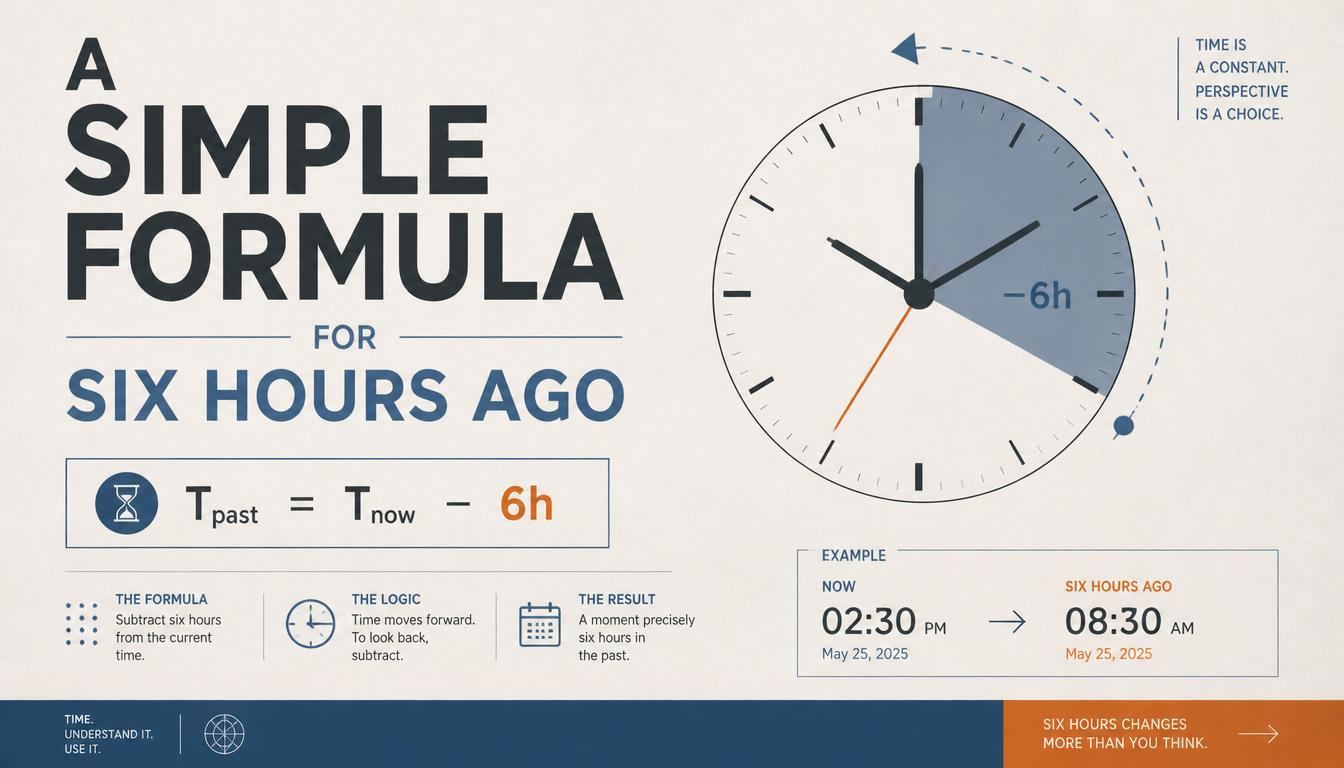
The easiest formula is:
Past Time = Current Time 6 hours
If you prefer minutes:
Past Time = Current Time 360 minutes
And using seconds:
Past Time = Current Time 21,600 seconds
For milliseconds:
Past Time = Current Time 21,600,000 milliseconds
This makes it easy to understand the relationship between different units. Whether you’re using an analog clock, digital timestamp, spreadsheet, calculator, or programming language, the underlying idea stays the same.
How to Find the Exact Time Six Hours Ago
If you want to find the time six hours ago, follow these simple steps:
- Look at your Current Time.
- Identify the hour and minute.
- Subtract six hours.
- Keep the minutes unchanged.
- Check whether the result crosses midnight.
- If it crosses midnight, move the date back by one day.
- Confirm the AM/PM designation.
For example, current time = 2:30 AM.
Subtract six hours:
2:30 AM → 8:30 PM previous day
So the exact time six hours ago was 8:30 PM on the previous date.
It really is that simple once midnight stops trying to sneak into the calculation.
How to Make Time Calculations Easier
For ordinary situations, mental Clock Calculation is enough. If you’re calculating several intervals or working with international schedules, use a reliable time calculation tool.
A good relative time calculator can be especially useful when you need to compare:
Current Time → Past Time → Future Time
For example, you could calculate six hours ago, then calculate six hours from now, and compare both results with a calendar.
For professional work, always include the time zone when exact records matter. “3:00 PM” by itself can be ambiguous. “3:00 PM GMT+5” tells someone much more.
Frequently Asked Questions
What Time Was It 6 Hours Ago?
Six hours ago is found by subtracting 6 hours from the current time.
How Do I Calculate 6 Hours Ago?
Subtract 6 hours from the current time. If needed, adjust the date when crossing midnight.
What Is 6 Hours Before 12 PM?
Six hours before 12 PM (noon) is 6 AM.
What Is 6 Hours Before 6 PM?
Six hours before 6 PM is 12 PM (noon).
Does 6 Hours Ago Change the Date?
Yes. If you subtract 6 hours and pass midnight, the result will be on the previous calendar day.
Read This Blog:https://wevorix.com/until-330/
Final Thoughts on What Time Was It 6 Hours Ago?
The answer to What Time Was It 6 Hours Ago is simply the current time minus six hours. Yet behind that small calculation is a surprisingly useful idea about how humans organize their days.
Six hours equals 360 minutes, 21,600 seconds, or 21,600,000 milliseconds. Whether you’re checking a meeting, reviewing a server log, tracking a delivery, calculating a sleep period, or remembering when a beautiful family moment happened, the same basic principle applies.
And sometimes, six hours is more than six hours. It can be the space between waiting and meeting a newborn daughter, between a late-night message and a morning reply, or between one ordinary moment and something that changes everything.
So the next time you wonder about 6 hours ago from now, look at the clock, subtract six hours, check the date, and you’re there. Time may move quietly, but with a little Time Determination, you can always find your way back to a particular moment.
