
There is something strangely beautiful about waiting for a date that has not arrived yet.
A family may be preparing for a baby girl, a student may be counting toward an important exam, or someone might simply be wondering when a certain Thursday will appear on the calendar.
We often say, “a few weeks from now,” but when the appointment, celebration, delivery, or family gathering is important, guessing the date can feel a little risky.
That is where a Weeks From Now Calculator becomes useful. Instead of manually moving through a calendar and wondering whether you counted one week twice, you can enter a number of weeks and quickly discover the corresponding future date.
It is a small piece of date calculation, yes, but sometimes small things are exactly what save us from a messy little mistake.
Imagine a family waiting for the arrival of a baby girl. Grandma might say, “She could be here in several weeks,” while an uncle starts counting the Fridays on his old wall calendar. Someone else opens a phone and counts forward.
Five minutes later, everybody has a different answer, which is honestly how family mathematics sometimes works. A simple calculator brings everyone back to the same exact date.
| Weeks From Now | Approximate Date |
|---|---|
| 3.5 weeks | October 12, 2026 |
| 36 weeks | May 27, 2027 |
| 37 weeks | June 3, 2027 |
| 38 weeks | June 10, 2027 |
| 47 weeks | August 12, 2027 |
What Is a Weeks From Now Calculator?
A Weeks From Now Calculator is an online date calculator designed to determine a date after a specified time period measured in weeks. You provide a calculator input, usually the number of weeks, and the tool produces the corresponding calculator output.
For example, if today is September 17, 2026, and you want to know the date 4 weeks from now, the answer is October 15, 2026. The interesting part is that four full weeks always contain 28 days, so the calculation moves forward by exactly 28 days while keeping the same day of the week.
This makes a weeks calculator handy for planning appointments, school deadlines, family occasions, travel arrangements, shipment arrival dates, business transactions, and even personal countdowns. You dont need to become a human calendar just to answer a simple date question.
How Does the Weeks From Now Calculator Work?
The process is wonderfully simple. The calculator starts with the current date, adds the selected number of weeks, and displays the resulting future date. Most tools use a straightforward calendar calculation behind the scenes, so the user only needs to provide a numeric value.
If you enter 1 week, the calculator moves seven days forward. Enter 2 weeks, and it moves 14 days. Enter 10 weeks, and it moves 70 days. Nothing mysterious is happening in the background, although the result can feel surprisingly satisfying when a date lands exactly where you expected it to.
The input field is usually where you enter the number of weeks. After that, the results may show the exact date, date and time information, the day of the week, and sometimes additional details such as the week number or day number. Its basically a tiny calendar assistant sitting there without asking for coffee.
Why Use a Weeks From Now Calculator?

People often think they can simply manually count weeks on a calendar, and technically they can. The trouble begins when the date is several months away. Counting seven days at a time sounds easy until your finger is jumping across months and you suddenly wonder whether you counted March 31 twice.
A calculator reduces that uncertainty. It can help you calculate weeks from today, determine an upcoming date, and plan a future event without spending unnecessary time checking every square on the calendar. For people who work with schedules often, that convenience adds up rather quickly.
Parents, teachers, students, event planners, offices, travelers, and families preparing for meaningful occasions can all use a future date calculator. Even something as simple as deciding when to send invitations can become easier when you know the exact date instead of saying, “sometime around next month.”
Weeks From Now: A Simple Example
Suppose the current date is September 17, 2026, which is a Thursday. If you want to know what date is 1 week from now, simply move seven days ahead.
That brings you to September 24, 2026, also a Thursday. Add another seven days and 2 weeks from now becomes October 1, 2026. Another week gives October 8, and suddenly your simple little countdown has turned into a neat chain of Thursday dates.
Here is a useful sequence:
| Weeks From Today | Future Date | Day |
|---|---|---|
| 0 weeks | September 17, 2026 | Thursday |
| 1 week | September 24, 2026 | Thursday |
| 2 weeks | October 1, 2026 | Thursday |
| 3 weeks | October 8, 2026 | Thursday |
| 4 weeks | October 15, 2026 | Thursday |
| 5 weeks | October 22, 2026 | Thursday |
| 6 weeks | October 29, 2026 | Thursday |
| 7 weeks | November 5, 2026 | Thursday |
| 8 weeks | November 12, 2026 | Thursday |
| 9 weeks | November 19, 2026 | Thursday |
| 10 weeks | November 26, 2026 | Thursday |
| 11 weeks | December 3, 2026 | Thursday |
| 12 weeks | December 10, 2026 | Thursday |
The pattern is easy to spot. Because you are adding complete weeks, the day of the week stays the same. Thats one of the nicest little clues when checking your calculation manually.
Weeks From Now Calculator for Longer Time Periods
Short calculations are easy enough, but longer periods are where a Weeks From Now Calculator really starts earning its keep. When someone asks, “What date is 26 weeks from today?” most people do not want to flip through six months of calendar pages.
Starting from September 17, 2026, some longer milestones are:
- 13 weeks → December 17, 2026
- 14 weeks → December 24, 2026
- 15 weeks → December 31, 2026
- 16 weeks → January 7, 2027
- 17 weeks → January 14, 2027
- 18 weeks → January 21, 2027
- 19 weeks → January 28, 2027
- 20 weeks → February 4, 2027
- 21 weeks → February 11, 2027
- 22 weeks → February 18, 2027
- 23 weeks → February 25, 2027
- 24 weeks → March 4, 2027
- 25 weeks → March 11, 2027
- 26 weeks → March 18, 2027
And the calendar keeps walking quietly forward, one Thursday after another. There is something almost poetic about it when you think about a family waiting for a special milestone, especially the excitement surrounding a daughter who has not yet arrived.
What Date Is X Weeks From Today?

The phrase “what date is X weeks from today” is really asking for a date calculation based on the current day. Replace X with any number, such as 3, 10, 20, or 40, and the calculator can determine the answer.
For instance, 10 weeks from today means moving forward 70 days. 20 weeks from today means moving forward 140 days.
40 weeks from today represents 280 days, which is also why week-based counting is commonly used when discussing pregnancy timelines, though actual pregnancy experiences can vary considerably.
The useful thing about a weeks to date calculator is that you dont have to translate weeks into months yourself. Months have different lengths, while weeks represent fixed seven day intervals, making them convenient for precise planning.
What Date Is X Weeks From Now?
The question “what date is X weeks from now” has the same basic meaning, but it usually refers to the moment when the calculation is performed. If the calculator is being used on September 17, 2026, then 5 weeks from now is October 22, 2026.
This can be particularly useful when arranging events several weeks ahead. Perhaps a family reunion is planned, a school project has a deadline, or someone wants to know when a parcel might arrive. Instead of writing “late October” on a note, you can record the actual exact future date.
Future Dates From 27 to 40 Weeks
Longer calculations can be especially useful for people planning well ahead. Starting with September 17, 2026, the following dates continue the weekly sequence:
- 27 weeks → March 25, 2027
- 28 weeks → April 1, 2027
- 29 weeks → April 8, 2027
- 30 weeks → April 15, 2027
- 31 weeks → April 22, 2027
- 32 weeks → April 29, 2027
- 33 weeks → May 6, 2027
- 34 weeks → May 13, 2027
- 35 weeks → May 20, 2027
- 36 weeks → May 27, 2027
- 37 weeks → June 3, 2027
- 38 weeks → June 10, 2027
- 39 weeks → June 17, 2027
- 40 weeks → June 24, 2027
Notice that every result remains a Thursday. Thats because adding whole weeks changes the date but not the weekday, which makes weekly planning wonderfully predictable.
From 41 Weeks to 53 Weeks

Sometimes you need a calculation covering almost an entire year. A date calculator by weeks can handle those larger values without making you count page after page.
Continuing the same calculation:
- 41 weeks → July 1, 2027
- 42 weeks → July 8, 2027
- 43 weeks → July 15, 2027
- 44 weeks → July 22, 2027
- 45 weeks → July 29, 2027
- 46 weeks → August 5, 2027
- 47 weeks → August 12, 2027
- 48 weeks → August 19, 2027
- 49 weeks → August 26, 2027
- 50 weeks → September 2, 2027
- 53 weeks → September 23, 2027
The supplied date sequence through September 2, 2027 corresponds to 50 weeks from September 17, 2026. A full 52 week period is 364 days, so it does not quite equal a standard 365 day year. Thats a small calendar detail, but an important one when planning exact intervals.
Weeks and Days: Why the Difference Matters
A weeks and days calculator can be helpful when your required interval is not a whole number of weeks. For example, perhaps an event is 5 weeks and 3 days away. That is different from simply saying 5 weeks because the extra three days matter when you are planning a deadline.
A week contains seven days, so 0 weeks means no movement from the starting date, while 1 week means seven days, 2 weeks means 14 days, and so on. Once you understand that relationship, most basic weekly calculations become quite friendly.
The calculator can also be used alongside a day countdown. One tool answers the question in weeks, while another may show the total number of days remaining. Sometimes seeing both is useful because “12 weeks” feels abstract, while “84 days” feels very specific.
How to Use the Calculator Correctly
Using an online date calculator usually takes only a few moments. Start by identifying today’s date or the date you want to use as the starting point. Then locate the weeks input or input field and enter your desired numeric value.
If you enter 8 weeks, for example, the calculator should add eight complete seven-day intervals to the starting date. The resulting calculator output is your future date. Depending on the tool, you may also see the day of the year, week of the year, or other calendar information.
It is worth checking the starting date before trusting the answer, especially if you are not actually calculating from today.
A date calculator can be perfectly accurate while still giving the wrong result if the wrong starting date was entered. Computers are many things, but sadly they still cannot read our minds.
Weeks From Today for Planning Important Events

Date planning becomes much easier when you stop thinking only in months and start looking at exact intervals. An event that is “about two months away” might occur in 8 weeks, 9 weeks, or something slightly different depending on the months involved.
For family celebrations, this distinction can matter. Imagine parents preparing a welcoming ceremony for their baby girl.
They need to coordinate relatives, invitations, food, decorations, photography, and perhaps travel arrangements. Knowing the exact date after X weeks gives everybody a common reference point.
The same idea works for professional situations. A company may need to review a contract after 12 weeks, a customer may expect a shipment, or a team might schedule a project milestone several weeks ahead. A future date lookup makes these plans less dependent on guesswork.
Cultural and Family Traditions Around Welcoming a Baby Girl
The arrival of a baby girl often turns an ordinary date into a family landmark. Across cultures, families welcome newborns through different traditions, prayers, meals, gatherings, gifts, names, and family visits. The details vary widely, but the common thread is usually simple: everyone wants to mark the beginning of a new little life.
In many South Asian families, for example, the arrival of a daughter may bring relatives together for prayers, sweets, thoughtful gifts, and visits. Grandparents may remember the date for decades, while parents keep photographs and messages that turn one calendar day into a treasured family story.
That is why date tools can have an emotional side too. A future date calculator might appear purely mathematical, but behind that future date there could be a birthday, a family gathering, a medical appointment, a school milestone, or the day everyone has been waiting to welcome a little girl. Numbers sometimes carry more feeling than we expect.
A Few Warm Messages for a Baby Girl’s Future Milestone
When a family is counting weeks from now toward a meaningful occasion, the calculator can help establish the date, while a thoughtful message gives the date its heart.
- “May the weeks ahead bring peaceful moments, joyful preparations, and a beautiful welcome for your little girl.”
- “Every week brings you closer to another precious chapter, and we hope your family fills those days with laughter.”
- “May the future date on your calendar become a memory your family treasures for many years.”
- “A tiny daughter can make one ordinary calendar suddenly feel like the most important page in the whole year.”
- “Wishing your family patience for the waiting, happiness for the preparing, and endless blessings for the little one.”
- “May each passing week carry your family closer to a day filled with smiles, prayers, and happy tears.”
- “The calendar is counting the weeks, but your hearts are counting the moments.”
- “May your baby girl arrive into a home already overflowing with love.”
- “Some dates are written in ink, while others are written into the heart; may yours be both.”
- “Here’s to every week ahead and the beautiful memories waiting at the end of it.”
These messages can be adapted for a card, text message, social post, family invitation, or personal note. A small detail such as the baby’s name, expected celebration date, or a family tradition can make the words feel much less generic.
Understanding 260 Days and 365 Days

People sometimes compare weekly intervals with yearly intervals, and this is where calendar mathematics gets interesting. 260 days is approximately 37 weeks and 1 day, while 365 days is the length of a common calendar year.
However, 365 days is not exactly 52 weeks. Fifty two weeks contain 364 days, leaving one extra day. In a leap year, the calendar has 366 days. This is why saying “one year from today” and “52 weeks from today” can produce dates that are one day apart.
That difference is easy to miss when doing mental calculations. A date and time tool or online calendar date calculator can remove that little bit of confusion when precision matters.
Common Numbers of Weeks People Calculate
People use a Weeks From Now Calculator for surprisingly many intervals. Smaller values such as 1 week, 2 weeks, 3 weeks, and 4 weeks are common for appointments and short-term plans.
Medium ranges such as 5 weeks, 6 weeks, 7 weeks, 8 weeks, 9 weeks, 10 weeks, 11 weeks, and 12 weeks are useful for projects, school schedules, personal goals, and event planning. Larger ranges from 13 weeks through 20 weeks can help with longer-term preparation.
Some users may need 21 weeks, 22 weeks, 23 weeks, 24 weeks, 25 weeks, 26 weeks, 27 weeks, 28 weeks, 29 weeks, or 30 weeks. Others may enter 31 weeks through 40 weeks, particularly when they are working with long planning periods.
Even 41 weeks, 42 weeks, 43 weeks, 44 weeks, 45 weeks, 46 weeks, 47 weeks, 48 weeks, 49 weeks, 50 weeks, or 53 weeks can be calculated in the same basic way.
The number itself may change, but the underlying idea stays refreshingly simple: start with a date, add complete seven-day intervals, and read the resulting date.
Weeks From Now vs. Months From Now
Weeks and months are not interchangeable measurements. A week is always seven days, while a month may contain 28, 29, 30, or 31 days. That makes weeks more predictable when you need an exact time interval.
If somebody says an event is “two months away,” you still need to look at the specific months to know the number of days involved. If they say it is “8 weeks away,” the interval is fixed at 56 days.
This is why a weeks calculator can be more convenient for recurring schedules and fixed intervals. A time calculator may help with hours and minutes, while a date calculator handles calendar movement. Each tool has its own little job, and honestly, letting each one do its job saves a lot of unnecessary head-scratching.
Practical Uses for a Future Date Calculator
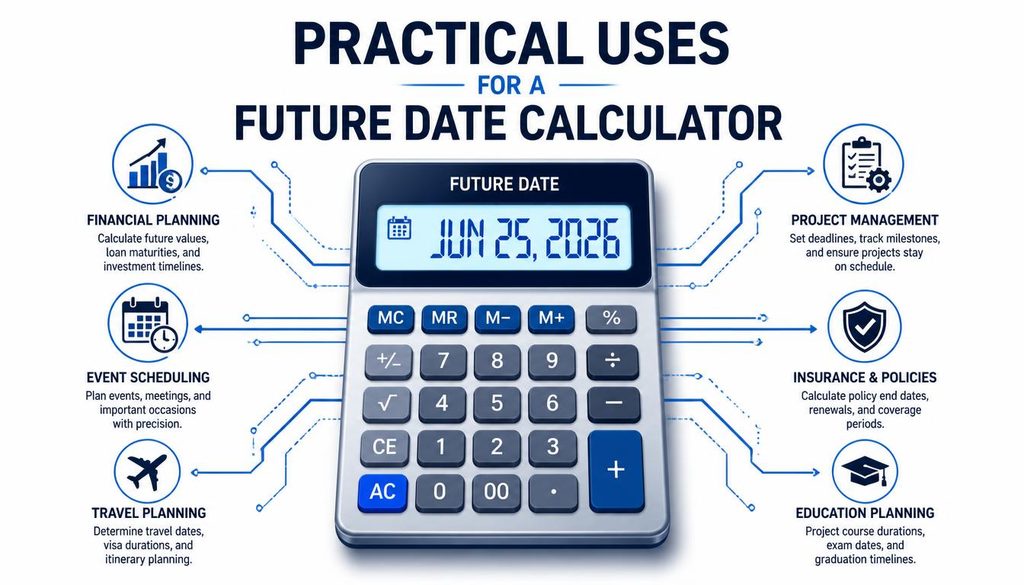
There are plenty of everyday reasons to calculate a future date. A person waiting for a shipment might estimate an arrival period. A business may schedule a follow-up. A teacher might set a review date. A family may organize a gathering.
Other examples include:
- Shipment arrival date planning
- School and university deadlines
- Appointment scheduling
- Vacation and travel planning
- Project milestones
- Subscription or contract reviews
- Family celebrations
- Birthday and anniversary preparation
- Event invitation planning
- Personal countdowns
- Weekly date calculation
- Long-term schedule planning
The point is not that a calculator replaces a calendar. It simply makes the calendar easier to use when the interval is measured in weeks.
Tips for Getting the Most Accurate Results
Before entering a number of weeks, make sure you know which starting date you actually mean. “From today” should refer to the current date being used by the calculator, while a custom calculation may begin from another date entirely.
Also remember that 0 weeks means the starting date itself. 1 week means seven days later. If you are checking a result manually, count complete seven day intervals rather than simply moving from one calendar month to another.
Finally, check the day of the week. If you add a whole number of weeks, the weekday should remain unchanged. If your starting date is Thursday and you calculate 20 complete weeks forward, the result should also be a Thursday. This simple check can catch an accidental entry surprisingly fast.
How to Write a Pers onal Message Around a Future Date
A calculator gives you the date, but it cannot give you the emotion behind it. That part belongs to people. If the date is connected to a baby girl, family celebration, or another special occasion, start by mentioning what the date means rather than simply stating the number of weeks.
For example, instead of writing only, “Your event is 6 weeks away,” you could say that six weeks brings the family closer to a joyful gathering. Add the baby’s name if appropriate, mention a family tradition, or include a short blessing. Suddenly the exact date becomes part of a story instead of just another number on a screen.
A good message does not need complicated poetry. Sometimes “We are counting every week until we can finally celebrate with you” feels more genuine than a paragraph full of fancy words. Simple words can carry a surprisingly large suitcase of emotion.
Frequently Asked Questions
38 weeks from today
38 weeks from today is approximately June 10, 2027.
36 weeks from today
36 weeks from today is approximately May 27, 2027.
37 weeks from today
37 weeks from today is approximately June 3, 2027.
47 weeks from today
47 weeks from today is approximately August 12, 2027.
3.5 weeks from today
3.5 weeks from today is approximately October 12, 2026.
Read This Blog:https://wevorix.com/months-calculator/
Final Thoughts on the Weeks From Now Calculator
A Weeks From Now Calculator is a straightforward tool, but its usefulness stretches far beyond simple arithmetic. It helps you calculate weeks from today, find a date after a number of weeks, identify an exact future date, and organize the weeks ahead with less confusion.
From September 17, 2026 to September 2, 2027, the examples above show how a weekly interval can move through seasons, months, holidays, and eventually almost an entire year. Every seven days turns the page once more, quietly and reliably.
And perhaps that is why dates can feel so special. A future date is not only a position on a calendar. It may represent a family reunion, a new beginning, an important appointment, a long-awaited celebration, or the day a baby girl becomes the newest and smallest member of a loving family.
So whether you are trying to answer “what date is X weeks from now,” “how many weeks from now,” or simply hoping to find a date X weeks from now, a reliable calculator can make the process quick and clear. Enter the calculator input, check the calculator results, and let the calendar do the counting.
Then, when the special day finally arrives, the number of weeks will matter much less than the memories made along the way. And thats probably the nicest thing about counting forward: eventually, the future date stops being future at all, and becomes a day you get to remember.
