
There is a funny little moment in every kitchen when a recipe says “100 grams” and the only measuring tool sitting nearby is a tablespoon.
You look at the recipe, then the spoon, then back at the recipe, hoping the answer might somehow appear by itself. It usually doesn’t. And this is where grams to tablespoons conversion becomes surprisingly useful.
Just like welcoming a baby girl into a family can turn an ordinary day into something completely new, learning a small kitchen conversion can change the way you approach cooking. Suddenly, measurements that once felt confusing start making sense.
A grandmother measuring flour by instinct, a parent preparing a cake for a child’s birthday, or someone trying a recipe from another country may all need to move between mass and volume measurements.
The important thing to remember is that grams and tablespoons don’t measure exactly the same thing. Grams measure mass, while a tablespoon measures volume.
The difference sounds tiny when you’re standing in a kitchen, but it matters quite a lot when you’re measuring ingredients.
So, if you’ve ever searched for “how many grams in a tablespoon,” “how many tablespoons is 100 grams,” or “how to convert grams to tablespoons,” you’re in the right place.
This guide explains the science, the practical shortcuts, ingredient differences, and the safest way to make an accurate unit conversion.
| Conversion | Approximate Value |
|---|---|
| 1 gram (g) | 0.067 tbsp |
| 10 grams | 0.67 tbsp |
| 25 grams | 1.67 tbsp |
| 50 grams | 3.33 tbsp |
| 100 grams | 6.67 tbsp |
| 1 tbsp | 15 grams |
| 2 tbsp | 30 grams |
| 3 tbsp | 45 grams |
| 4 tbsp | 60 grams |
| 5 tbsp | 75 grams |
What Are Grams and Tablespoons?
A Gram is a metric unit used to measure mass. It is commonly used for food ingredients, powders, spices, baking ingredients, and many other everyday materials. Larger quantities can be expressed in kilograms, while smaller amounts may be measured in milligrams.
A Tablespoon, on the other hand, is a unit of volume. In many cooking contexts, one standard tablespoon is approximately 15 milliliters, although tablespoon sizes can vary depending on the measurement standard and country.
That difference is the whole secret behind this conversion. You aren’t simply swapping one label for another. You’re connecting mass measurement with volume measurement, and the bridge between them is density.
For example, a tablespoon of water and a tablespoon of flour occupy roughly the same volume, but they don’t weigh the same.
Flour contains more air and has a different structure, while water is much denser. This is why one universal number for grams to tbsp doesn’t work perfectly for every ingredient.
Grams to Tablespoons: The Basic Idea
When people search for a grams to tablespoons converter, they often expect a single fixed answer. Unfortunately, there isn’t one answer that applies to every food.
The conversion depends mainly on:
- The mass in Grams
- The volume of one Tablespoon
- The Density of the ingredient
- Whether the spoon is flat, rounded, or heaped
- The measurement standard being used
For many kitchen situations, the basic relationship can be represented as:
tablespoons = grams / density
When converting in the opposite direction:
grams = tablespoons × density
These simplified formulas work when density is expressed appropriately for the tablespoon volume being used.
This is why an ingredient-specific conversion calculator can be much more useful than simply memorizing one number.
A tablespoon of honey isn’t the same mass as a tablespoon of powdered sugar, even though the spoon itself holds the same approximate volume.
How to Convert Grams to Tablespoons

To convert grams to tablespoons, you first need to know what ingredient you’re measuring. Once you know its approximate density, you can determine how much volume corresponds to the given mass.
Imagine you’re working with water. Water has a relatively predictable density, so its conversion is fairly straightforward. But if you’re working with flour, the result can change depending on how tightly the flour is packed.
The general process is simple:
- Identify the ingredient.
- Find its approximate density.
- Determine the mass in grams.
- Apply the appropriate conversion formula.
- Round the result according to the precision your recipe requires.
For everyday cooking measurements, an approximate value is often perfectly fine. For delicate baking, however, a kitchen scale is generally more dependable than repeatedly converting between volume and mass.
How to Convert Tablespoons to Grams
The reverse calculation, tablespoons to grams, follows the same principle but moves from volume to mass.
Suppose a recipe calls for 4 tablespoons of an ingredient. You can’t automatically say that it weighs 60 grams simply because a tablespoon is around 15 ml. That would only work if the ingredient’s density made the mass correspond to that value.
This distinction becomes especially important with dry ingredients.
A tablespoon of sugar, a tablespoon of flour, and a tablespoon of butter can all have different weights. The spoon is measuring volume, but the kitchen scale is measuring mass.
For that reason, a good tbsp to g converter should always take the ingredient into account.
Why Density Matters So Much
Density describes how much mass is contained within a certain volume. In simple kitchen language, it helps explain why two ingredients that occupy the same amount of space can have completely different weights.
Think of a tablespoon filled with cotton and another tablespoon filled with sand. The volume is similar, but the mass is wildly different. Food ingredients aren’t quite that dramatic, but the principle is the same.
Water has a relatively high and predictable density. Flour is lighter because of the spaces between particles. Honey is comparatively heavy because it has a higher density. Oils also have different densities from water.
Therefore, grams to tablespoons based on density is more accurate than assuming that every ingredient behaves like water.
1 Tablespoon in Grams: Is There One Answer?

The frequently searched question “how many grams are in one tablespoon?” doesn’t have a universal answer.
For water, one tablespoon is approximately 15 ml, and because water’s density is close to 1 gram per milliliter, the mass is around 15 grams.
But if the tablespoon contains another ingredient, the number changes.
For example, depending on the exact ingredient and how it is measured:
| Ingredient | Approximate weight of 1 tbsp |
|---|---|
| Water | ~15 g |
| Granulated sugar | ~12 13 g |
| Flour | ~7 9 g |
| Honey | ~20 21 g |
| Butter | ~14 g |
| Cooking oil | ~13 14 g |
These values are practical estimates rather than laboratory measurements. Brand, packing method, temperature, moisture, and spoon size can all create little differences.
Grams to Tablespoons for Water
Grams to tablespoons water is one of the easiest kitchen conversions because water has a relatively consistent density.
Since a standard tablespoon is approximately 15 ml, and water weighs about 1 gram per milliliter, the relationship is close to:
- 15 grams of water ≈ 1 tablespoon
- 30 grams of water ≈ 2 tablespoons
- 45 grams of water ≈ 3 tablespoons
- 60 grams of water ≈ 4 tablespoons
- 75 grams of water ≈ 5 tablespoons
- 150 grams of water ≈ 10 tablespoons
This is also why recipes sometimes treat milliliters and grams of water as nearly interchangeable for everyday cooking. Still, they’re technically different types of measurement units.
Grams to Tablespoons for Oil
Oil behaves differently because oil density is lower than water density.
If you’re converting grams to tablespoons oil, the exact answer depends on the type of oil. Palm oil, sunflower oil, and coconut oil don’t necessarily have identical densities.
For example, many cooking oils are roughly in the range where a tablespoon weighs around 13–14 grams, but the actual figure varies.
That means:
- 14 g oil ≈ 1 tbsp
- 28 g oil ≈ 2 tbsp
- 42 g oil ≈ 3 tbsp
- 56 g oil ≈ 4 tbsp
Treat these as useful kitchen estimates, not precision laboratory values.
Sugar: Grams to Tablespoons

Sugar is another ingredient where people frequently need a sugar grams to tablespoons conversion.
Granulated sugar generally has a different density from powdered sugar. Brown sugar can be especially tricky because recipes may specify whether it should be firmly packed.
A rough kitchen reference might look like this:
| Sugar type | Approximate 1 tbsp |
|---|---|
| Granulated sugar | 12 13 g |
| Brown sugar | ~13 14 g when packed |
| Powdered sugar | ~7 8 g |
So if a recipe asks for 100 grams of granulated sugar, it won’t necessarily equal the same number of tablespoons as 100 grams of powdered sugar.
This is one reason professional bakers often prefer accurate ingredient measurements using grams.
Flour and Cornstarch Conversions
Flour grams to tablespoons is another conversion where packing matters. Flour is light and contains tiny air pockets, so scooping it directly with a spoon can produce inconsistent results.
For many all-purpose flour measurements, one level tablespoon may weigh around 7–9 grams.
That means 100 grams of flour could be somewhere around 11–14 tablespoons, depending on the measurement technique.
Cornstarch is also relatively light. If you are converting cornstarch, don’t use a flour conversion automatically. Different powders have different densities, and even the same powder can settle differently.
When baking, weighing flour in grams is usually the better choice because a few extra tablespoons can noticeably change the texture of cakes, bread, cookies, or pastry.
Honey and Other Thick Ingredients
Honey is a classic example of why density matters.
One tablespoon of honey weighs substantially more than one tablespoon of flour because honey is denser. Therefore, a direct volume to mass comparison can be misleading.
The same general idea applies to syrups, molasses, sauces, and other thick liquids.
If you’re working with honey, a digital kitchen scale can save you from sticky measuring spoons and from guessing whether your tablespoon was truly full. It’s one of those tiny kitchen victories that feels much bigger than it should.
Butter: A Common Recipe Conversion

Butter is commonly listed in grams, tablespoons, sticks, or other regional measurements, which can make recipes feel like they’re speaking several languages at once.
A tablespoon of butter is often around 14 grams, so rough conversions might be:
- 1 tbsp butter ≈ 14 g
- 2 tbsp ≈ 28 g
- 3 tbsp ≈ 42 g
- 4 tbsp ≈ 56 g
- 5 tbsp ≈ 70 g
The exact value can vary slightly, particularly depending on whether the butter is softened, packed, or cut from a block.
Quick Grams to Tablespoons Chart
Here is a useful general reference for understanding the scale of common conversions. These numbers are not ingredient-universal; they are most useful as a starting point for water-like measurements.
| Grams | Approx. tablespoons for water |
|---|---|
| 15 g | 1 tbsp |
| 30 g | 2 tbsp |
| 45 g | 3 tbsp |
| 60 g | 4 tbsp |
| 75 g | 5 tbsp |
| 150 g | 10 tbsp |
| 225 g | 15 tbsp |
| 300 g | 20 tbsp |
| 450 g | 30 tbsp |
| 750 g | 50 tbsp |
| 1500 g | 100 tbsp |
For flour, sugar, oil, honey, or other ingredients, use an ingredient-specific conversion instead.
Tablespoons to Grams Chart
The reverse direction can also be useful when a recipe gives tablespoons but your scale is ready on the counter.
For water-like measurements:
| Tablespoons | Approx. grams of water |
|---|---|
| 1 tbsp | 15 g |
| 2 tbsp | 30 g |
| 3 tbsp | 45 g |
| 4 tbsp | 60 g |
| 5 tbsp | 75 g |
| 10 tbsp | 150 g |
| 15 tbsp | 225 g |
| 20 tbsp | 300 g |
| 30 tbsp | 450 g |
| 50 tbsp | 750 g |
| 100 tbsp | 1500 g |
Again, these figures shouldn’t be copied onto every ingredient without thinking. That’s where ingredient density enters the kitchen and quietly changes the answer.
How Many Tablespoons Is 100 Grams?

The answer depends entirely on the ingredient.
For water, 100 grams is approximately 6.67 tablespoons because one tablespoon contains roughly 15 grams of water.
For flour, sugar, oil, or honey, the number will be different.
So when someone asks, “how many tablespoons is 100 grams?” the best follow-up is mentally: “100 grams of what?”
That tiny missing word can completely change the calculation.
How Many Grams Is 10 Tablespoons?
For water, 10 tablespoons are approximately 150 grams.
But for other ingredients, the answer changes according to density. Ten tablespoons of honey, for example, weigh much more than ten tablespoons of flour.
This is why an ingredient-based kitchen measurement calculator is handy when you’re dealing with several recipe ingredients at once.
1 Gram in Tablespoons
A single gram is a very small amount compared with a tablespoon.
For water, 1 gram is approximately 0.067 tablespoon, or about 1/15 of a tablespoon.
This is more naturally measured with a kitchen scale, particularly for tiny quantities such as spices, baking soda, baking powder, or specialty ingredients.
If you need very small amounts regularly, teaspoons or a precision scale may be more practical than trying to estimate fractions of a tablespoon.
10, 20, 50, 100, 200, 500 and 1000 Grams in Tablespoons

For water-like density, the approximate relationship is straightforward:
- 10 grams ≈ 0.67 tbsp
- 20 grams ≈ 1.33 tbsp
- 50 grams ≈ 3.33 tbsp
- 100 grams ≈ 6.67 tbsp
- 200 grams ≈ 13.33 tbsp
- 500 grams ≈ 33.33 tbsp
- 1000 grams ≈ 66.67 tbsp
These figures are useful for understanding numerical conversion, but they should not be treated as universal ingredient values.
If you’re measuring flour, butter, sugar, oil, or another food, use the ingredient’s density instead.
Tablespoons, Teaspoons and Milliliters
A tablespoon doesn’t exist alone in the kitchen measurement universe. It has smaller and larger relatives.
In common cooking measurements:
- 1 tablespoon ≈ 15 milliliters
- 1 tablespoon = 3 teaspoons
- 1 teaspoon ≈ 5 milliliters
- 2 tablespoons ≈ 30 milliliters
- 4 tablespoons ≈ 60 milliliters
You may see tbsp, TBS, or simply “tablespoon” in recipes. Likewise, teaspoon is commonly abbreviated as tsp.
The exact standard can vary internationally, which is another reason recipes from different countries sometimes produce slightly different results.
Flat Tablespoon vs Heaped Tablespoon
A flat tablespoon is leveled so that the ingredient is approximately even with the top edge of the spoon.
A heaped tablespoon contains additional material above the rim.
That sounds obvious, but it creates a substantial difference when measuring flour, sugar, spices, or powders.
If a recipe doesn’t specify “heaped,” a level measurement is generally easier to reproduce consistently.
For serious baking, however, a scale is still preferable because “heaped” can mean something different to every person. One person’s mountain is another person’s tiny hill, apparently.
US Tablespoon vs International Tablespoon
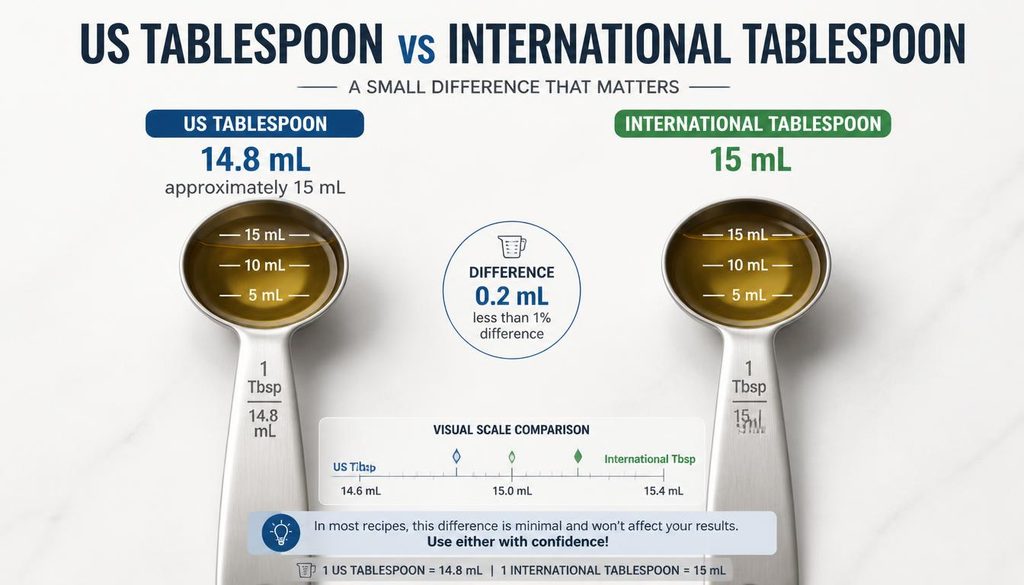
Not every tablespoon in the world is exactly the same size.
A common US tablespoon is approximately 14.79 ml, while many metric cooking systems use 15 ml. Some Australian recipes use a 20 ml tablespoon.
This creates cultural differences and measurement standards that matter when precision is important.
If you’re following an international recipe, check which measurement system the recipe uses before performing a gram tablespoon conversion.
Why a Kitchen Scale Is Often More Accurate
A measuring spoon is excellent for convenience. A kitchen scale is excellent for precision.
When a recipe gives an ingredient in grams, weighing it directly eliminates much of the uncertainty created by volume. This is particularly valuable for:
- Baking flour
- Sugar
- Cocoa powder
- Spices
- Butter
- Yeast
- Baking soda
- Baking powder
- Coffee
- Small recipe batches
A scale measures mass directly, while a spoon measures volume. Neither is inherently “better” for every situation, but they answer different measurement questions.
Measuring Liquid Ingredients
Liquid ingredients are often easier to measure with a jug or measuring spoon because their volume is relatively easy to observe.
For water, milk, broth, and many liquid ingredients, milliliters per tablespoon provides a convenient bridge between volume units.
Oils can also be measured by volume, although their mass differs from water because of their lower density.
When a recipe gives liquid ingredients in grams, a scale can still be used. Just place the container on the scale, tare it, and add the required mass.
Measuring Dry Ingredients

Dry ingredients require a little more care.
Flour should generally be spooned into a measuring cup and leveled rather than compressed. Brown sugar is often intentionally packed. Powdered ingredients can settle or become compacted.
Spices are another interesting case because tiny differences may influence a dish, especially when a spice is particularly strong.
For dry ingredient conversion, knowing the ingredient and its packing method is more important than simply knowing the tablespoon volume.
A Short History of Kitchen Measurement
Long before modern measuring spoons existed, cooks relied on whatever was available: hands, cups, bowls, shells, pottery, household spoons, and visual judgment.
The history of cutlery is surprisingly connected to everyday measurement because utensils evolved alongside eating and food preparation.
During the Middle Ages, spoons and other utensils varied greatly in shape and capacity. By the Renaissance, decorative and functional cutlery became increasingly developed among wealthy households.
Eventually, mass production made standardized kitchen tools easier to manufacture and distribute. Modern stainless steel measuring spoons are a far cry from the ornate silver cutlery and gold cutlery once associated with status.
Today, professional designers focus on practical details such as durable materials, ergonomic handles, accurate capacities, and easy cleaning. It’s a very long journey from ancient utensils to the humble measuring spoon sitting beside your mixing bowl.
Common Kitchen Tools for Accurate Measurement
A useful kitchen doesn’t need dozens of complicated gadgets.
A basic collection might include:
- Digital kitchen scale
- Measuring spoons
- Measuring cups
- Liquid measuring jug
- Teaspoon
- Tablespoon
- Mixing bowls
- Standard kitchen utensils
A set of stainless steel measuring spoons can last for years, while plastic sets can be lighter and cheaper. Some decorative silver or gold cutlery sets may be beautiful, but ordinary standardized measuring spoons are generally more useful for actual recipe work.
The important thing isn’t how fancy the spoon looks. It’s whether its capacity is known and used consistently.
Common Mistakes When Converting Grams to Tablespoons

The most common mistake is assuming that one tablespoon always weighs 15 grams.
Fifteen is primarily a useful approximation for the volume of a tablespoon in milliliters. It doesn’t automatically mean 15 grams of every ingredient.
Other common mistakes include:
- Ignoring ingredient density
- Using a heaped spoon when the recipe means level
- Forgetting regional tablespoon differences
- Compressing flour into the spoon
- Assuming powdered sugar weighs like granulated sugar
- Confusing teaspoons with tablespoons
- Rounding too aggressively
- Treating an approximate conversion as a laboratory measurement
Once you understand these issues, measurement accuracy becomes much easier.
When Should You Use a Conversion Calculator?
An online grams to tablespoons converter is useful when you need a quick answer and don’t have the ingredient’s density memorized.
A good online converter can save time when adapting recipes, scaling portions, or switching between metric and volume-based instructions.
It’s particularly helpful for people who regularly work with recipes from different countries. One recipe may use grams, another tablespoons, another cups, and another milliliters. A digital unit calculator helps bring all those systems into the same kitchen.
Still, calculators are only as reliable as the density information behind them. If the ingredient is unusually packed, aerated, moist, or processed, the real-world result may differ slightly.
Grams to Tablespoons for Different Cooking Ingredients
There is no single conversion table that perfectly handles every ingredient, but these categories show why ingredient-specific conversion matters:
Water
Water is among the easiest ingredients for conversion because its density is relatively consistent. Around 15 grams of water is approximately one 15 ml tablespoon.
Oil
Cooking oils weigh less per tablespoon than water because their density is lower. Palm oil, sunflower oil, and coconut oil may each have slightly different values.
Sugar
Granulated sugar, brown sugar, and powdered sugar have different textures and densities. Brown sugar can also be packed, making its mass change considerably.
Flour
Flour is light and easily compressed. Leveling and packing can make a noticeable difference.
Honey
Honey is dense, so one tablespoon weighs considerably more than a tablespoon of flour.
Butter
Butter has a relatively consistent structure but can be measured differently depending on whether it is solid, softened, or melted.
Baking Soda and Baking Powder
These are used in small amounts, so precision matters. A scale or standardized measuring spoon is generally more reliable than guessing.
How to Make Recipe Measurements More Personal

Cooking isn’t only mathematics. A recipe may be connected to a birthday, a family dinner, a holiday, or even the first cake made for a newborn daughter.
That’s why accurate recipe measurements can matter emotionally as well as practically. If you’re making a cake to welcome a baby girl into the family, for example, getting the flour and sugar proportions right is part of creating that little memory.
A grandmother may have an old recipe written in tablespoons. A younger family member may prefer grams. Converting between them lets both versions of the recipe survive without forcing either generation to abandon its familiar method.
Sometimes the most meaningful recipes are the ones that have survived imperfectly, with a little flour on the page and a measurement crossed out from twenty years ago.
How to Convert a Recipe from Grams to Tablespoons
If you want to convert an entire recipe, don’t simply multiply every gram value by one universal factor.
Instead:
- List every ingredient separately.
- Identify whether it is liquid, solid, powder, or granulated.
- Find an appropriate density or trusted ingredient conversion.
- Convert each ingredient independently.
- Keep the original gram values alongside the converted measurements.
- Test the recipe if precision matters.
This approach gives you a more reliable recipe conversion and prevents one ingredient’s density from being incorrectly applied to another.
How to Convert Tablespoons to Grams
For tablespoons to grams conversion, follow the same ingredient-first approach.
Start with the number of tablespoons, determine the approximate mass of one tablespoon of that ingredient, and multiply.
For example, if an ingredient weighs approximately 12 grams per tablespoon and a recipe uses 5 tablespoons:
5 × 12 = 60 grams.
The arithmetic is easy. The difficult part is selecting the correct conversion factor.
That is why the conversion factor should come from the specific ingredient rather than from the tablespoon itself.
Why Standard Measurement Matters
Cooking becomes easier when everyone understands what a measurement means.
Standard measurement helps recipes travel between kitchens, families, countries, and generations. Without standardization, “one spoonful” could mean almost anything.
Modern metric units provide a particularly consistent framework because grams, kilograms, milliliters, and liters fit into a decimal system.
But traditional measurements remain popular because they’re fast and familiar. A cook rarely wants to weigh exactly 7 grams of salt when a teaspoon is sitting right there.
The best approach is knowing when convenience is enough and when precision is worth the extra few seconds.
Frequently Asked Questions
50g to tbs
50g is approximately 3.3 tablespoons for water-like ingredients. The exact amount may vary by ingredient density.
115g to tbsp
115g is approximately 7.7 tablespoons for water-like ingredients. Different ingredients may give different results.
45g to tbsp
45g is approximately 3 tablespoons for water-like ingredients. For dry ingredients, the conversion depends on density.
40 grams to tbsp
40 grams is approximately 2.7 tablespoons for water-like ingredients. The exact conversion varies by ingredient.
85 grams to tablespoons
85 grams is approximately 5.7 tablespoons for water-like ingredients. Ingredient density can affect the exact measurement.
Read This Blog:https://wevorix.com/weeks-left-in-year-calculator/
Final Thoughts on Grams to Tablespoons
At first glance, grams to tablespoons looks like one of those tiny kitchen questions that shouldn’t require much thought.
Yet once you look closer, it opens a surprisingly interesting door into mass, volume, density, measurement standards, and the way people have cooked across generations.
The biggest lesson is simple: grams and tablespoons are not interchangeable without considering the ingredient.
Water, oil, sugar, flour, honey, butter, cornstarch, baking soda, and spices all behave differently. A tablespoon tells you roughly how much space something occupies, while grams tell you how much mass it has. Density connects those two worlds.
So the next time a recipe says 100 grams and your measuring spoons are staring back at you from the drawer, don’t panic. Identify the ingredient, check its approximate density, use an appropriate conversion formula, and remember that a small difference is often harmless in everyday cooking.
And perhaps that’s part of what makes kitchens special. Measurements may be scientific, but the reasons we measure are often deeply human:
making a birthday cake, preparing a family meal, recreating an old recipe, or celebrating the arrival of a baby girl whose tiny presence has somehow made the whole house feel different.
Use a scale when precision matters, use measuring spoons when convenience matters, and keep your original recipe measurements whenever possible. With that simple habit, g to tbsp, tbsp to g, and other cooking measurement conversions become much less mysterious.
If you’ve discovered a useful conversion for a favorite ingredient, sharing it with other home cooks can be helpful too. Sometimes one small kitchen trick becomes the thing someone else needed to finish their recipe without making a flour-covered mess at 10 p.m.
