
There are some questions that look almost comically simple until you are standing in front of an oven with a recipe open on your phone, wondering why the numbers suddenly seem to belong to two different planets. What is 175 degrees Celsius in Fahrenheit?
The answer is 175°C = 347°F, exactly, and that little conversion can be surprisingly useful when you’re baking a cake, roasting vegetables, translating an international recipe, or simply trying to understand a temperature mentioned by someone in another country.
It’s one of those tiny pieces of information that saves dinner from becoming a small disaster, which is honestly worth knowing.
If you live in the United States, you may see 347°F and instinctively think, “Okay, but my oven has 350°F.” And there’s the interesting part: for ordinary cooking, 175°C is very close to 350°F, although the exact conversion is 347°F.
That three-degree difference usually isn’t a dramatic thing in a home oven, but understanding the distinction between an exact conversion and a convenient oven approximation makes temperature conversion much less mysterious.
| Celsius | Fahrenheit |
|---|---|
| 175°C | 347°F |
Formula: °F = (°C × 9/5) + 32
175°C = 347°F
175 Degrees Celsius in Fahrenheit: The Quick Answer
The direct answer is simple: 175 Degrees Celsius in Fahrenheit is 347°F. If a recipe says to preheat your oven to 175°C, a Fahrenheit oven can generally be set to 347°F, assuming it allows that exact number, which many home ovens don’t.
For practical baking, you will often see 175°C → approximately 350°F for typical oven settings. That is because many ovens in the United States use temperature increments such as 325°F, 350°F, 375°F, and 400°F, rather than every possible degree.
So if you’re standing there thinking, “Should I set my oven to 350°F for 175°C?”, the practical answer is usually yes, unless the recipe or appliance gives you a reason to be more exact.
In other words, 175°C = 347°F, while 350°F = approximately 176.7°C. They are extremely close, but they are not mathematically identical. Cooking, as it turns out, has room for a little imperfection.
The same answer covers several common searches people type when they’re in a hurry, including 175 Celsius to Fahrenheit, 175 c to Fahrenheit, 175c in Fahrenheit, 175 degrees Celsius to Fahrenheit, and what is 175 Celsius in Fahrenheit. All roads, in this particular case, lead to 347°F.
How to Convert 175 Celsius to Fahrenheit
The standard Celsius to Fahrenheit conversion uses a straightforward equation:
F = (C × 9/5) + 32
Here, C represents the temperature in Celsius and F represents the temperature in Fahrenheit. It looks a little more intimidating than it actually is, really.
For 175°C, substitute 175 for C:
F = (175 × 9/5) + 32
First multiply 175 by 9:
175 × 9 = 1,575
Then divide by 5:
1,575 ÷ 5 = 315
Finally, add 32:
315 + 32 = 347
So the exact result is:
175°C = 347°F
That is the whole Celsius-to-Fahrenheit formula, without the smoke and mirrors. It is a linear conversion, meaning the relationship between the two scales follows a consistent mathematical pattern rather than changing randomly at different temperatures.
For anyone using a temperature converter, temperature calculator, or temperature calculator online, the same mathematical relationship is being used behind the scenes.
A digital tool simply does the arithmetic faster, while knowing the formula lets you check the answer yourself when needed.
175°C in Fahrenheit for Cooking and Baking
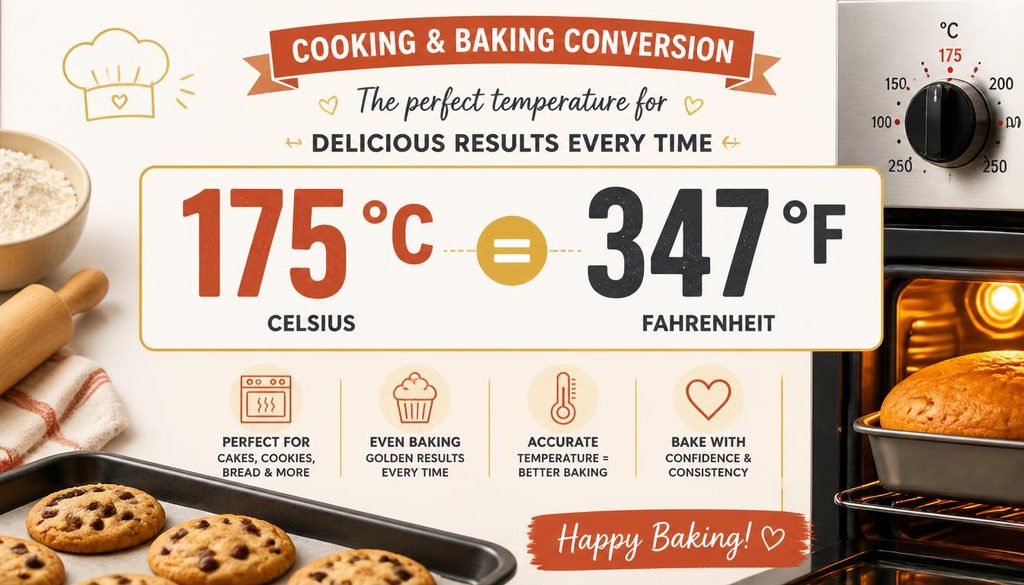
This is where the number becomes more than just a number. In the kitchen, 175°C in Fahrenheit is 347°F, and it commonly falls into the territory of a moderate oven temperature.
It is warm enough for plenty of baking and roasting jobs, but not so aggressive that everything instantly develops a blackened personality.
A 175°C oven setting can work well for cakes, some cookies, muffins, quick breads, casseroles, and roasted vegetables. Exact recommendations depend on the particular recipe, pan, oven, altitude, ingredients, and cooking method, so temperature alone never tells the entire story, obviously.
For a vanilla cake, sponge cake, or chocolate cake, moderate heat can encourage a gradual rise while allowing the center to cook before the outside becomes overly dark.
The goal is an even texture, a reliable crumb structure, and a consistent rise, rather than simply getting the oven as hot as possible.
The same idea applies to muffins and cupcakes. A controlled baking temperature helps the batter expand at a useful pace.
Too much heat too early can encourage excessive browning or burning edges before the interior has properly set, which is a rather sad way for a perfectly innocent cupcake to end its day.
Is 175°C Good for Baking?
Yes, 175°C is good for baking many foods, especially cakes, muffins, quick breads, cookies, and similar recipes, though the ideal temperature always depends on the recipe. Calling it a universal baking temperature would be too broad, because different batters and doughs behave differently.
At this level of moderate heat, the oven can provide enough energy for batter expansion, moisture evaporation, browning, and structural changes without necessarily producing harsh surface scorching.
The result you’re looking for is generally a balance between a cooked interior and a pleasantly browned exterior.
A cake baked at an appropriate temperature develops its cake structure as proteins, starches, fats, sugars, and water respond to heat. The chemistry sounds grand when written down, but in the kitchen it mostly means you’re hoping the cake rises properly and doesn’t come out with a crater in the middle.
For banana bread, 175°C can be a useful baking temperature depending on the recipe. Banana bread contains considerable moisture and sugar, so keeping the heat moderate can help the middle cook while reducing the risk of overly dark edges.
Your particular pan matters too, because a dark metal pan and a pale metal pan don’t always behave exactly the same way.
175°C Oven Temperature Compared With Fahrenheit Settings
Recipes travel. A cake recipe written in France, a cookbook printed in Germany, a family recipe from Pakistan, and an American food blog may all describe the same oven temperature using different units. That’s where oven temperature conversion becomes especially handy.
Here are several common reference points:
| Celsius | Fahrenheit |
|---|---|
| 0°C | 32°F |
| 20°C | 68°F |
| 30°C | 86°F |
| 100°C | 212°F |
| 160°C | 320°F |
| 170°C | 338°F |
| 175°C | 347°F |
| 180°C | 356°F |
| 190°C | 374°F |
| 200°C | 392°F |
The nearby temperatures are useful because recipes don’t always use 175°C exactly. You might encounter 170°C → 338°F, 180°C → 356°F, 190°C → 374°F, or 200°C → 392°F instead, and having the surrounding values in your head makes quick decisions a lot easier.
If your oven only offers 325°F, 350°F, 375°F and similar settings, you don’t need to panic over every single degree. For 175°C, 350°F is normally the convenient practical choice.
Still, if you’re working in a laboratory, manufacturing environment, or another setting where exact temperature measurement matters, approximation is a different matter entirely.
Why Celsius and Fahrenheit Give Different Numbers

The Celsius and Fahrenheit scales don’t use the same numerical reference points, which is why the same physical temperature gets different numbers. This isn’t because one scale is “wrong”; they simply have different histories and intervals.
On the Celsius scale, water freezes at 0°C and boils at 100°C under standard atmospheric conditions. On the Fahrenheit scale, those familiar reference points are 32°F and 212°F. The gap between freezing and boiling is therefore 100 degrees on the Celsius scale and 180 degrees on the Fahrenheit scale.
That difference in spacing is why the conversion includes multiplication by 9/5 before adding 32. The scales aren’t merely shifted versions of one another, they are scaled differently too.
The distinction becomes especially obvious when you compare everyday reference points. 0°C → 32°F, 20°C → 68°F, and 30°C → 86°F. Those numbers may look unrelated at first glance, but the conversion formula connects them neatly once you see the pattern.
Celsius, Fahrenheit, and Kelvin Explained
There is another temperature scale worth knowing: Kelvin. The kelvin is the SI unit of thermodynamic temperature, and the Bureau International des Poids et Mesures (BIPM) identifies it as an SI base unit. The degree Celsius has the same size interval as one kelvin, although the numerical zero points differ. BBIPM+1
For practical purposes, the relationship is:
K = °C + 273.15
Therefore:
175°C = 448.15 K
Kelvin is particularly important in science, engineering, climate studies, physics, and technical work. You are unlikely to open a muffin recipe and see “Bake at 448.15 K,” thankfully, because that would make breakfast feel like a university entrance exam.
The modern SI framework defines the kelvin through fundamental physical constants, rather than simply treating a historical water reference as the ultimate definition. BIPM explains that the degree Celsius is equal in magnitude to the kelvin, while Celsius temperature is related to thermodynamic temperature through the 273.15 offset. BBIPM
What Is 175°C Used for in an Oven?
A 175°C oven temperature is common enough in everyday cooking that it deserves a place in your mental conversion toolbox. It can appear in recipes for cakes, cookies, muffins, brownies, cupcakes, quick breads, and various savory dishes.
For roasted vegetables such as carrots, potatoes, zucchini, and cauliflower, moderate oven heat can encourage gradual browning and moisture loss. The final result depends heavily on cutting size, oil, moisture, tray arrangement, and cooking time too, because vegetables have their own little opinions about how quickly they should surrender.
In casseroles, baked pasta, and pasta bakes, 175°C can provide enough heat to warm and cook the dish while allowing sauces and toppings to develop texture. A fruit crumble can similarly benefit from moderate heat, giving the topping time to brown while the fruit softens underneath.
For every recipe, however, the listed temperature should be considered alongside cooking time and visual cues. If a recipe says 175°C but your oven runs noticeably hot, the actual result can differ.
Home ovens are not always as precise as their displays make them look, which is one reason experienced bakers learn to watch the food as well as the clock.
Is 175°C the Same as 350°F?

Not exactly, but they’re very close.
The exact Celsius to Fahrenheit conversion tells us that:
175°C = 347°F
Meanwhile:
350°F = approximately 176.7°C
So if a recipe from Europe says 175°C and your American oven has a 350°F setting but doesn’t let you select 347°F, 350°F is generally the sensible practical setting for ordinary home baking. The difference is only about 3°F.
This is a good example of the difference between exact conversion and approximate conversion. In scientific temperature measurement, you may need the exact number.
In home cooking, a three-degree difference can be far less important than oven calibration, pan position, ingredient temperature, and cooking time.
So, yes, 175°C is approximately 350°F for typical oven settings, but remember that the mathematically exact Fahrenheit value is 347°F. Both statements can be true without contradicting each other, which is one of those small details that saves a lot of online arguments.
175 Celsius to Fahrenheit: Common Search Questions
People ask the same conversion in many slightly different ways, usually because they are holding a recipe in one hand and trying to search with the other. Here are the answers in plain language.
- What is 175 degrees Celsius in Fahrenheit? 347°F, exactly.
- What is 175 Celsius in Fahrenheit? 347°F.
- What is 175 C in Fahrenheit? 347°F.
- 175 Celsius equals what Fahrenheit? It equals 347°F.
- What is the Fahrenheit equivalent of 175 Celsius? 347°F.
- How much is 175°C in Fahrenheit? 347°F.
- What temperature is 175°C for baking? 347°F, or commonly about 350°F on a household oven.
- What is 175°C on a Fahrenheit oven? Set it to about 347°F, or 350°F where that is the nearest practical setting.
- Should I set my oven to 350°F for 175°C? Usually yes for ordinary home baking, if 347°F isn’t an available setting.
- Is 175°C a moderate oven temperature? Yes, it is generally considered a moderate baking temperature.
These answers may look repetitive on purpose, because search intent is repetitive. A person asking “175c to Fahrenheit” usually doesn’t need a philosophical essay about temperature scales, they need the number before their cookies turn into archaeology.
175 Degrees Celsius to Fahrenheit in International Recipes
Temperature conversion becomes especially useful when recipes cross borders. A cookbook in London, a food website in New York, a family kitchen in Lahore, or a recipe shared between friends in Toronto may use different measurement conventions.
Much of Europe uses Celsius in recipes, while American recipes commonly use Fahrenheit. Australia and New Zealand also generally use Celsius for cooking, so an international recipe can easily require a little unit conversion before you begin.
Imagine finding a beautiful sponge cake recipe from Paris that says 175°C, while your oven display in America speaks only Fahrenheit.
Nothing is wrong with either measurement system. The recipe and the appliance are simply using different temperature languages.
This is why recipe temperature conversion is a small but important part of global cooking. Recipes cross borders constantly now, and a temperature converter makes that exchange much easier. Metric and customary measurements can coexist quite happily, even if they make the cook do a tiny bit of arithmetic first.
175°C Beyond the Kitchen: Science and Industry

Although most people search for 175 Celsius to Fahrenheit because of a recipe, temperature conversion has much bigger applications. Engineers, researchers, manufacturers, and technicians regularly translate measurements between systems when reading specifications or collaborating internationally.
A technical document may describe a process in Celsius while equipment documentation uses Fahrenheit. This can happen in science laboratories, engineering projects, medical research, industrial production, manufacturing, and product quality control.
Temperature can also matter in plastic processing, metal treatment, electronics production, material testing, and other industrial applications. In these environments, a seemingly small numerical difference may matter much more than it does when you’re baking banana bread.
International manufacturing creates another reason for accurate conversion. Equipment can be designed in one country, manufactured in another, and operated somewhere else entirely.
Clear measurement standards and careful unit conversion reduce the chance of misunderstanding technical specifications, which is considerably more important when you’re dealing with machinery than when you’re deciding whether the brownies need another five minutes.
Exact Conversion Versus Practical Cooking Conversion
One of the most useful lessons here is that “exact” and “practical” aren’t always the same thing. Mathematically, 175°C = 347°F. That’s the exact answer from the conversion formula.
Practically, however, a recipe may tell an American cook to use 350°F. That’s because kitchen appliances often use convenient preset temperatures. The recipe writer may also have rounded the temperature for simplicity, and home ovens themselves can fluctuate during operation.
For a cake, 347°F versus 350°F usually isn’t the kind of distinction that deserves a sleepless night. The bigger factors are often oven accuracy, baking time, pan size, rack position, and the actual characteristics of the recipe.
In a scientific experiment, though, you shouldn’t casually replace a specified value with an approximation unless the procedure allows it. Scientific temperature conversion should preserve the required precision, especially in calibration, testing, research, and industrial temperature control.
A Handy 175°C Conversion Cheat Sheet
If you regularly cook from international recipes, keeping a few nearby values in mind can make things much faster. These are useful reference points, though your own oven’s behavior should still be considered.
- 160°C = 320°F, a useful lower baking reference.
- 170°C = 338°F, slightly cooler than the temperature in question.
- 175°C = 347°F, the exact answer we’re after.
- 180°C = 356°F, a very common baking temperature.
- 190°C = 374°F, noticeably hotter and useful for many roasted or baked dishes.
- 200°C = 392°F, a higher cooking temperature used for many recipes.
- 100°C = 212°F, the familiar boiling point of water under standard conditions.
- 0°C = 32°F, the familiar freezing point reference.
Seeing these values side by side makes temperature conversion feel less like memorizing random numbers and more like understanding a connected scale. Once you know a handful of reference points, the rest becomes easier to estimate, although exact calculations are still better when precision matters.
A Note About Oven Accuracy
There is a sneaky little variable in all of this: your oven may not actually be at the temperature printed on its display. Home ovens can cycle above and below their target temperature as they maintain heat, and different ovens can behave differently.
That means a recipe calling for 175°C isn’t necessarily improved by obsessing over whether the display says 347°F or 350°F. If your oven is poorly calibrated, the difference between those settings may be less important than the oven’s actual internal temperature.
For frequent bakers, an inexpensive oven thermometer can be useful. It can reveal whether your oven tends to run hotter or cooler than expected, which may explain why one person’s vanilla cake rises beautifully while another person’s comes out suspiciously dramatic.
This also explains why cooking instructions often include sensory clues such as “golden brown,” “set in the center,” or “until a toothpick comes out clean.” Numbers matter, but food itself is giving you information too.
Frequently Asked Questions
What is 175 Degrees Celsius in Fahrenheit?
175°C is equal to 347°F.
How Do You Convert 175°C to Fahrenheit?
Use the formula °F = (°C × 9/5) + 32. For 175°C, the result is 347°F.
Is 175°C a High Temperature?
Yes, 175°C (347°F) is a moderately high oven temperature commonly used for baking and roasting.
What Is 175°C in Fahrenheit for an Oven?
A 175°C oven is approximately 347°F. If your oven uses common settings, 350°F is a close equivalent.
What Is the Difference Between 175°C and 347°F?
There is no difference in temperature; 175°C and 347°F represent the same temperature in different scales.
Read This Blog:https://wevorix.com/what-time-was-it-5-hours/
Final Answer: 175°C = 347°F
So, after all the formulas, ovens, recipes, science, and international measurement systems, the answer remains beautifully uncomplicated:
175°C = 347°F
If you’re converting an oven temperature, 175°C is approximately 350°F on many household ovens, making 350°F the practical choice when your oven does not offer a 347°F setting.
The Celsius-to-Fahrenheit formula is:
F = (C × 9/5) + 32
And for 175°C:
(175 × 9/5) + 32 = 347°F
Whether you’re translating a cake recipe from Europe, preparing roasted vegetables, checking a technical document, studying temperature scales, or simply satisfying a very specific question that appeared in your head at six in the morning, that’s the number to remember.
Temperature is one of those invisible things that quietly shapes almost everything around us. It determines whether chocolate melts, bread rises, vegetables brown, metals change, materials behave differently, and experiments produce useful results.
A tiny conversion like 175 Celsius to Fahrenheit is therefore more than arithmetic; it’s a little bridge between different systems of measurement.
And if you’re about to put a cake in the oven, remember the practical version: 175°C means 347°F, with 350°F being the common rounded oven setting. Your cake probably won’t complain about those three degrees, though it may still judge you for opening the oven door every four minutes.
