
Have you ever glanced at the clock in the middle of a busy morning and wondered, “How long until 2:45 PM?”
Maybe you’re waiting for your lunch break, counting down to an important appointment, planning a school pickup, or simply looking forward to the moment your workday begins to feel a little shorter.
Whatever the reason, knowing how much time remains until 2:45 PM can make an ordinary day feel more organized.
Time has a funny way of behaving. When you’re excited about something, the minutes seem to walk instead of run. When you’re busy, an entire morning can disappear before you’ve even finished your coffee.
And sometimes, 2:45 PM feels just around the corner, while on other days it seems to be hiding at the far end of the afternoon.
The good news is that calculating the remaining time is simple once you know the current time. In this guide, we’ll explore how to calculate the countdown to 2:45 PM, how to plan your daily activities around it, and how to avoid common time-calculation mistakes.
We’ll also look at practical examples for students, employees, parents, and anyone who wants to manage their hours a little better.
| Detail | Information |
|---|---|
| Target Time | 2:45 PM |
| Current Time | Check your local clock |
| Time Remaining | Depends on the current time |
| Time Format | 12-hour clock |
| Purpose | Calculate the time until 2:45 PM |
How Long Until 2:45 PM?
The answer depends on your current local time. There isn’t one fixed countdown that applies throughout the day because every passing minute changes the amount of time left.
For example, if it’s 10:00 AM, you have 4 hours and 45 minutes until 2:45 PM. If your clock reads 1:00 PM, the wait is much shorter: just 1 hour and 45 minutes.
Here are a few examples to make the calculation easier:
- If it’s 8:00 AM, there are 6 hours and 45 minutes until 2:45 PM.
- If it’s 9:00 AM, there are 5 hours and 45 minutes remaining.
- If it’s 10:00 AM, there are 4 hours and 45 minutes left.
- If it’s 11:00 AM, you have 3 hours and 45 minutes to go.
- If it’s 12:00 PM, there are 2 hours and 45 minutes remaining.
- If it’s 1:00 PM, you have 1 hour and 45 minutes left.
- If it’s 2:00 PM, only 45 minutes remain.
- If it’s 2:30 PM, there are just 15 minutes to go.
These examples show how quickly the countdown changes as the morning progresses. A time that seems far away early in the day can suddenly feel very close after lunch.
How to Calculate the Time Until 2:45 PM
You don’t need a special calculator to figure out the time remaining until 2:45 PM. A clock, a little subtraction, and a moment of concentration are usually enough.
The easiest method is to compare the current time with the target time.
Suppose your clock shows 10:20 AM. First, count the hours from 10:20 AM to 2:20 PM. That’s four hours. Then count from 2:20 PM to 2:45 PM, which adds another 25 minutes.
Your total is 4 hours and 25 minutes.
Here’s another example. Imagine it’s 12:35 PM and you’re waiting for a meeting that starts at 2:45 PM. From 12:35 PM to 2:35 PM is two hours, followed by another 10 minutes. That means you have 2 hours and 10 minutes left.
You can also use the following simple formula:
Time remaining = Target time − Current time
This works when both times fall on the same day and the current time is earlier than the target. If it is already past 2:45 PM, you’ll need to calculate the time until 2:45 PM tomorrow instead, unless you’re referring to an earlier event.
For a quick result, enter your current local time into a time calculator and set the target to 2:45 PM. Just remember to select AM or PM correctly, because mixing the two can create a surprisingly large error.
Why 2:45 PM Can Be an Important Time
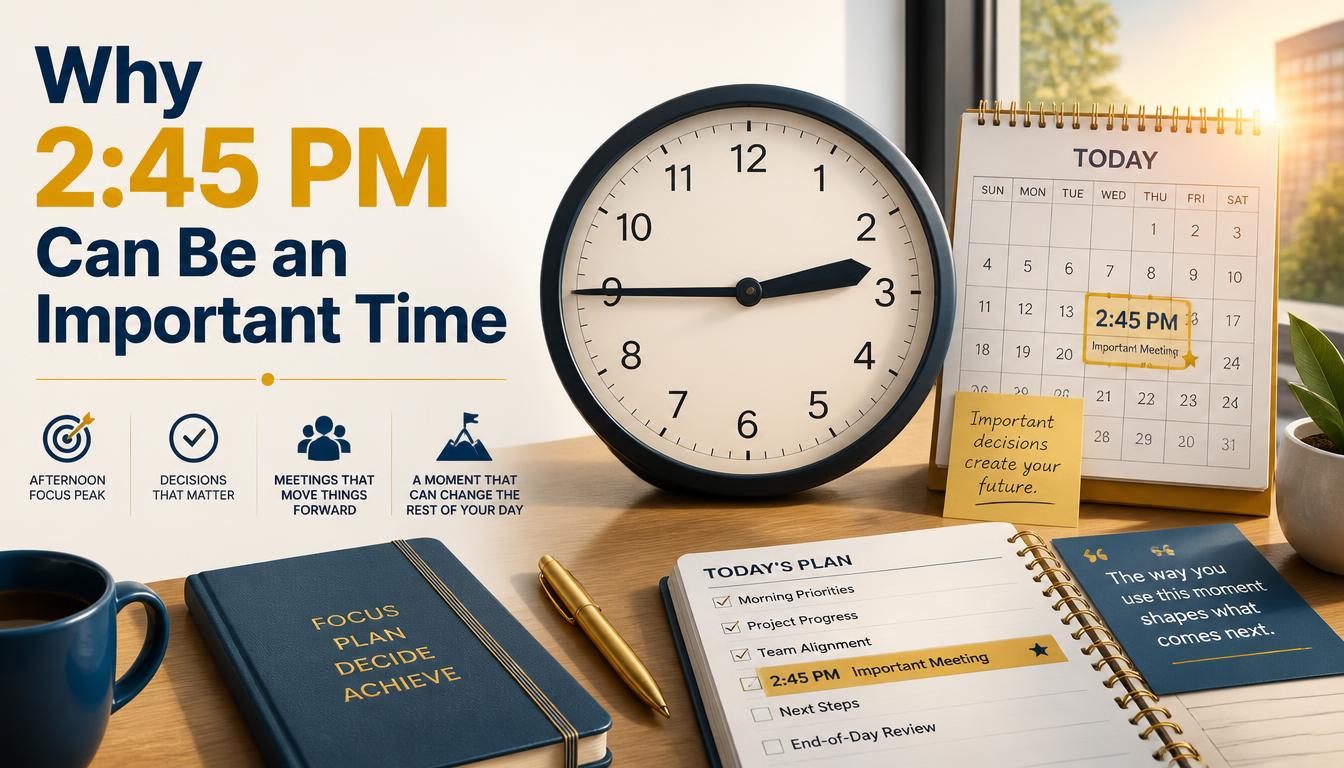
A specific time can mean something different to everyone. For one person, 2:45 PM is the final stretch of a school day. For another, it marks a doctor’s appointment, an afternoon delivery, or the moment they can finally leave their desk for a short break.
Think about a parent who has spent the morning working while keeping one eye on the clock. At 2:45 PM, perhaps a child finishes school, and the family’s afternoon routine begins.
That one time on the clock becomes more than a number; it’s a small point around which the day is organized.
For students, it might be the end of a lesson or the beginning of an extracurricular activity. For office workers, it may signal a scheduled call or the last important task before the workday winds down.
Having a clear target time can also help reduce uncertainty. Instead of repeatedly asking how much longer you have to wait, you can plan the remaining minutes and give each task a reasonable place in your schedule.
How Long Until 2:45 PM From Different Morning Times?
Sometimes, a quick reference is more useful than doing the arithmetic yourself. The following table shows the time remaining until 2:45 PM at several common morning and afternoon times.
| Current time | Time until 2:45 PM |
|---|---|
| 7:00 AM | 7 hours, 45 minutes |
| 8:00 AM | 6 hours, 45 minutes |
| 9:00 AM | 5 hours, 45 minutes |
| 10:00 AM | 4 hours, 45 minutes |
| 10:30 AM | 4 hours, 15 minutes |
| 11:00 AM | 3 hours, 45 minutes |
| 11:30 AM | 3 hours, 15 minutes |
| 12:00 PM | 2 hours, 45 minutes |
| 12:30 PM | 2 hours, 15 minutes |
| 1:00 PM | 1 hour, 45 minutes |
| 1:30 PM | 1 hour, 15 minutes |
| 2:00 PM | 45 minutes |
| 2:15 PM | 30 minutes |
| 2:30 PM | 15 minutes |
| 2:40 PM | 5 minutes |
Notice that every time the clock advances by 30 minutes, the remaining countdown decreases by the same amount. This is an uncomplicated relationship, but it becomes useful when you’re planning several activities in a row.
If your current time isn’t listed, find the closest entry and adjust the difference. For instance, if it is 9:20 AM, the countdown is 20 minutes shorter than it would be at 9:00 AM. So instead of 5 hours and 45 minutes, you have 5 hours and 25 minutes left.
How Long Until 2:45 PM for Students?
For students, 2:45 PM can be a familiar landmark in the school day. It may be the time classes finish, a bus arrives, a sports practice begins, or an afternoon examination starts.
Knowing the remaining time can help students organize their work without feeling as though they must rush through everything at once.
Imagine a student arriving at school at 8:00 AM and discovering that the final class ends at 2:45 PM. That’s a total of 6 hours and 45 minutes between arrival and dismissal, assuming the student remains on campus throughout that period.
A practical way to manage the day is to break it into smaller sections:
- Use the first part of the morning for difficult subjects that require more concentration.
- Schedule a short review before lunch to reinforce what you’ve learned.
- Use the early afternoon to complete assignments or prepare questions for the teacher.
- Check your timetable before the final class so you’re ready for dismissal.
Of course, school schedules vary by country, institution, and grade level. In some places, children finish much earlier; in others, afternoon lessons continue beyond 2:45 PM.
The important lesson is that a clear target time can help students develop better habits. They learn to estimate how long a task might take, recognize when a break is needed, and finish work without leaving everything until the last moment.
How Long Until 2:45 PM at Work?

At work, watching the clock can feel almost like a second job. You’ve answered emails, attended meetings, completed a few tasks, and somehow the afternoon still seems to have plenty of minutes left.
If your scheduled break starts at 2:45 PM, calculating the remaining time can help you decide what to finish before stepping away.
Suppose it’s 12:15 PM. You have 2 hours and 30 minutes until your break. Rather than treating that period as one long stretch, divide it into smaller blocks.
You might spend the first 45 minutes completing a priority task, use the next 30 minutes to answer messages, and reserve the remaining time for a meeting or final review. Small plans like these can make a busy afternoon feel less scattered.
Here are a few useful ways to plan around 2:45 PM:
- Set a reminder 15 minutes before your scheduled appointment.
- Finish important work before the final few minutes instead of relying on a last-second rush.
- Leave enough time to travel to a meeting room or another workplace location.
- Keep a short list of unfinished tasks so you can resume them later.
- Use a calendar notification if you tend to lose track of time while concentrating.
The aim isn’t to fill every minute with work. A realistic schedule leaves room for unexpected requests, a glass of water, or simply a moment to breathe before moving to the next task.
How Long Until 2:45 PM for Parents and Caregivers?
For parents and caregivers, the afternoon often arrives with its own collection of responsibilities. School pickups, meal preparation, appointments, and family errands can all compete for attention.
If you need to collect a child at 2:45 PM, knowing the countdown helps you work backward. You can estimate your travel time, decide when to leave, and prepare anything you need before heading out.
For example, suppose the school is a 20-minute drive away and you want to arrive 10 minutes early. You should aim to leave at approximately 2:15 PM, provided traffic and other conditions are normal. If the journey is unpredictable, allowing more time is sensible.
A few small preparations can make the afternoon easier:
- Pack school bags or sports equipment before lunchtime.
- Check the route and traffic conditions before leaving.
- Set a reminder early enough to avoid rushing.
- Keep important pickup details accessible.
- Have a backup plan if an appointment or meeting runs late.
These habits are especially helpful on days when several family members have different schedules. Even a simple countdown can turn a stressful afternoon into a more manageable one.
How Long Until 2:45 PM in 12-Hour and 24-Hour Time?
Clocks can display the same moment in different formats. Understanding both makes time calculations easier, particularly when reading travel itineraries, digital schedules, or workplace timetables.
In the 12-hour format, the target is written as 2:45 PM. The PM designation means the time falls in the afternoon or evening portion of the day.
In the 24-hour format, the same time is written as 14:45.
Here are a few equivalent times:
- 12:00 PM = 12:00
- 1:00 PM = 13:00
- 2:00 PM = 14:00
- 2:30 PM = 14:30
- 2:45 PM = 14:45
- 3:00 PM = 15:00
The 24-hour system can be particularly useful because it avoids confusion between AM and PM. Hospitals, transportation services, and many workplaces use it to keep schedules clear.
For example, if a train schedule lists a departure at 14:45, that means 2:45 PM, not 2:45 AM. If you are calculating the time remaining until that departure, make sure your current time is expressed in the same format.
What If It’s Already Past 2:45 PM?

This is where the calculation changes slightly. If your local clock already shows a time later than 2:45 PM, the target time for today has passed.
For example, at 3:00 PM, 2:45 PM was 15 minutes ago. At 5:30 PM, it was 2 hours and 45 minutes ago.
But what if you’re asking how long until the next 2:45 PM? In that case, you need to count forward to the following afternoon.
If it is 3:00 PM today, the next 2:45 PM is tomorrow, which is 23 hours and 45 minutes away. If it is 8:00 PM, the next occurrence is 18 hours and 45 minutes away.
The same principle applies to any repeating daily time. Once today’s target has passed, move to the next calendar day and calculate the remaining interval.
This distinction is useful for recurring medication reminders, daily meetings, scheduled broadcasts, and routine activities. Always confirm whether you mean the time earlier today or the next occurrence tomorrow.
Common Mistakes When Calculating the Countdown
Time calculations are generally straightforward, but a few common errors can lead to an incorrect answer.
Confusing AM and PM
The difference between 2:45 AM and 2:45 PM is 12 hours. If you’re planning an afternoon appointment, double-check that you’ve selected PM.
Subtracting minutes incorrectly
Suppose it is 1:50 PM. You can’t simply subtract 50 from 45 and call the result negative five minutes. Instead, borrow one hour: 2:45 PM is 55 minutes after 1:50 PM.
Forgetting that noon is 12:00 PM
Noon marks the transition from morning to afternoon. The time 12:45 PM is 45 minutes after noon, while 12:45 AM is just after midnight.
Ignoring the current time zone
If you’re comparing a schedule from another country, the time shown may belong to a different time zone. Convert it to your local time before calculating the countdown.
Assuming the clock stays still
A calculation gives you the time remaining at the moment you make it. If you check again 10 minutes later, the countdown will be 10 minutes shorter, assuming the target hasn’t passed.
The best approach is to use a consistent time format, check the clock carefully, and repeat the calculation whenever accuracy matters.
How to Use a Countdown to Manage Your Day Better
A countdown to 2:45 PM can be more than a way to satisfy curiosity. Used thoughtfully, it can help you make better decisions about how to spend the time you have.
Start by identifying the reason you’re waiting for that particular time. Is it a meeting, an appointment, a break, or the end of a task? Once you know the purpose, you can work backward and decide what needs to happen before the target arrives.
For example, if you have three tasks to complete before 2:45 PM, estimate how long each one will take. If the total time exceeds the available window, choose the most important tasks first or move less urgent work to later in the day.
You can also use short checkpoints. If it’s 11:00 AM, decide what you want to have completed by noon. At lunchtime, review your progress and adjust the afternoon plan. By the time 2:45 PM approaches, you’ll have a clearer idea of what’s finished and what remains.
Don’t forget to leave room for breaks. Rest is not wasted time, and a schedule that allows no flexibility can become frustrating very quickly.
A useful countdown should support your day, not control every second of it.
Frequently Asked Questions
How long until 2:45 PM?
The time remaining until 2:45 PM depends on your current local time. Use a clock or countdown calculator to find the exact hours and minutes.
What time is 2:45 PM in 24-hour format?
2:45 PM in 24-hour time format is 14:45, commonly used on digital clocks and schedules.
How many minutes are there until 2:45 PM?
The number of minutes until 2:45 PM depends on the current time. Subtract the current time from 2:45 PM to calculate the difference.
How can I calculate the time until 2:45 PM?
Check your current local time and subtract it from 2:45 PM. If the target time is tomorrow, account for the hours remaining until midnight.
Is 2:45 PM in the morning or afternoon?
2:45 PM is in the afternoon. The PM designation covers the time from noon until just before midnight.
Read This Blog:https://wevorix.com/long-until-230-pm/
Final Thoughts: Make Every Minute Count Before 2:45 PM
So, how long until 2:45 PM? The answer begins with a simple glance at your clock. If it’s early in the morning, you may have several hours ahead of you. If the afternoon is already underway, the remaining time may be measured in minutes rather than hours.
The more useful question, however, might be what you’d like to do with that time. Perhaps you want to finish a project, enjoy a peaceful lunch, prepare for an appointment, or simply reach the end of a busy day. A little planning can make those minutes feel more purposeful.
Remember that time doesn’t need to be filled from one end to the other. Some moments are for working, some are for resting, and others are simply for enjoying the day as it unfolds.
If you’re waiting for 2:45 PM today, use the remaining time in a way that makes sense for you. Set a reminder if you need one, check your schedule, and give yourself enough room to handle the unexpected.
And if you have a favorite trick for managing your daily schedule or calculating the time until an important event, share it in the comments. Your simple tip might help someone else make their afternoon a little less hectic.
After all, 2:45 PM is just a time on the clock, but how you spend the minutes leading up to it is what gives those hours their value.
