
Time has a strange little habit of slipping away without asking anyone’s permission. You might wake up, check your phone, answer a few messages, and suddenly wonder when a particular conversation happened.
Maybe a friend was online earlier, a message arrived while you were asleep, or you simply want to know what time was it 16 hours ago. It sounds like a tiny question, but the answer can help make a confusing day feel a bit more organized.
Calculating time backward is easier than most people think. You don’t need a special clock, complicated mathematics, or a notebook filled with numbers. All you need is the current time, a little subtraction, and an understanding of what happens when you cross midnight.
In this guide, we’ll explain how to calculate 16 hours ago from now, explore examples using AM and PM, and show how a past time can fall on either the same day or the previous day.
We’ll also look at time zones, digital timestamps, and the everyday situations where knowing an earlier time becomes surprisingly useful.
| Calculation | Result |
|---|---|
| Time difference | 16 hours ago |
| Hours in a day | 24 hours |
| Calculation method | Current time − 16 hours |
| Time period | Previous day or same day |
| Main use | Find the exact time 16 hours ago |
What Time Was It 16 Hours Ago?
The answer depends on your current local time. To find the exact result, subtract 16 hours from the time displayed on your clock. Because the starting time changes throughout the day, there isn’t one fixed clock time that always represents 16 hours ago.
For example, if your clock currently shows 8:00 AM, subtracting 16 hours takes you back to 4:00 PM on the previous day. But if it shows 8:00 PM, the result is 4:00 AM on the same day.
Here are a few examples to make the calculation easier to understand.
| Current time | Time 16 hours ago | Day |
|---|---|---|
| 6:00 AM | 2:00 PM | Previous day |
| 8:00 AM | 4:00 PM | Previous day |
| 10:00 AM | 6:00 PM | Previous day |
| 12:00 PM | 8:00 PM | Previous day |
| 2:00 PM | 10:00 PM | Previous day |
| 6:00 PM | 2:00 AM | Same day |
| 8:00 PM | 4:00 AM | Same day |
| 11:00 PM | 7:00 AM | Same day |
The key detail is whether subtracting 16 hours takes you past midnight. If it does, you must also adjust the calendar date. Otherwise, the calculation stays on the same date.
How to Calculate 16 Hours Ago From Now
The easiest method is to subtract the hours in two smaller steps rather than trying to move backward all at once. Think of the clock as a circular path: you can move backward around it, but the calendar helps you keep track of which day you’re on.
Follow these simple steps:
- Check the current time on your phone, computer, or wall clock.
- Subtract the first 12 hours, which takes you to the opposite side of the clock.
- Subtract another 4 hours.
- Check whether your final answer belongs to today or yesterday.
- Confirm the AM or PM label before writing down your result.
Suppose the current time is 9:00 AM. Moving backward 12 hours takes you to 9:00 PM on the previous day. Subtracting four more hours gives you 5:00 PM on that previous day.
Therefore, 9:00 AM − 16 hours = 5:00 PM the previous day.
This simple approach is useful when you don’t have a calculator nearby. After trying it a couple of times, the process starts feeling more natural, almost like counting steps across a familiar room.
Understanding the Time Subtraction Formula
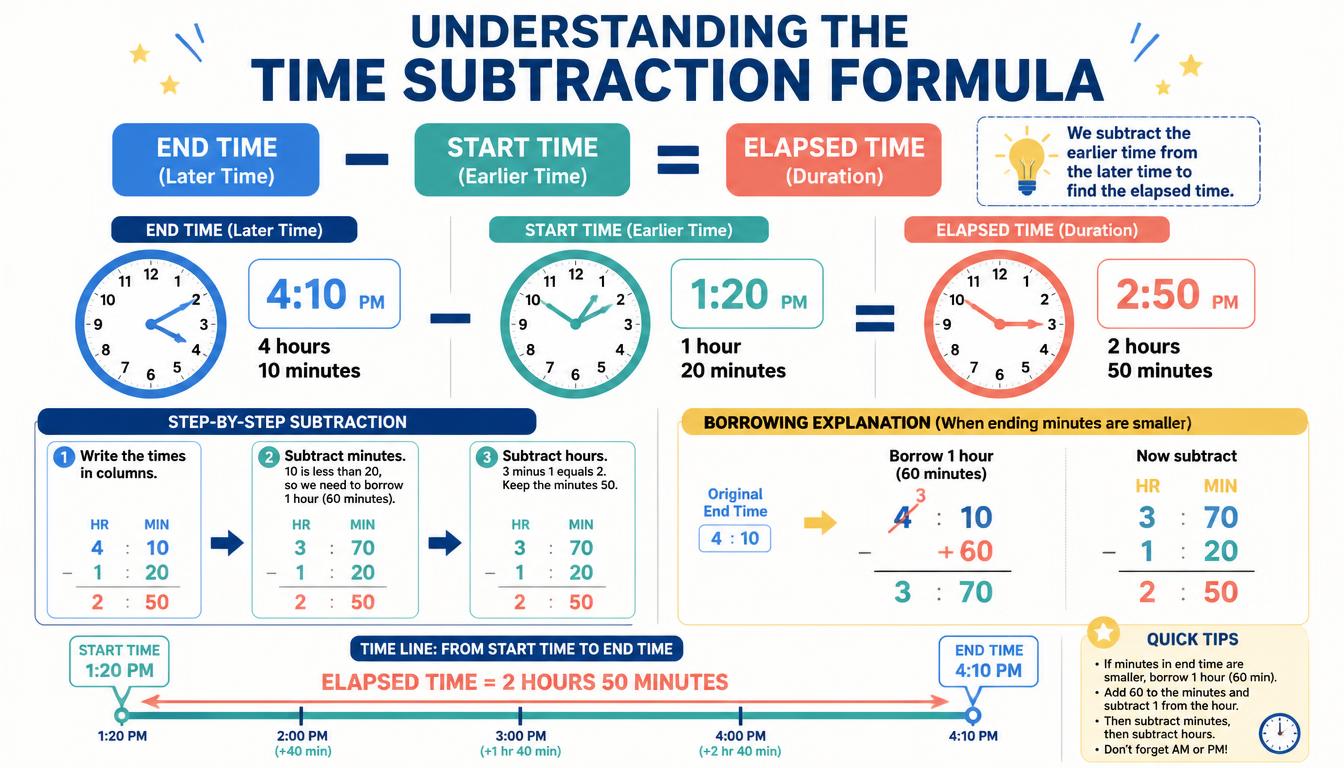
For anyone who prefers numbers over mental clock-watching, the time subtraction formula offers a reliable way to calculate a past time.
The basic formula is:
Past time = Current time − Elapsed time
In this example, the elapsed time is 16 hours. So the calculation becomes:
Past time = Current time − 16 hours
Sixteen hours is equivalent to 960 minutes or 57,600 seconds. In milliseconds, the same duration is 57,600,000 milliseconds.
| Time unit | Equivalent duration |
|---|---|
| Hours | 16 |
| Minutes | 960 |
| Seconds | 57,600 |
| Milliseconds | 57,600,000 |
These conversions can help when you’re working with a digital timestamp, a computer log, or an application that records time in seconds rather than displaying a familiar clock face.
For ordinary daily use, however, hours are usually enough. There’s no need to convert everything into milliseconds just to figure out when a message might have been sent.
How AM and PM Affect a 16-Hour Calculation
The 12-hour clock system divides the day into two periods: AM and PM. AM covers the time from midnight until just before noon, while PM covers noon until just before midnight.
This distinction matters because subtracting hours can change the AM/PM label. A calculation that starts in the morning might end in the afternoon or evening of the previous day.
Consider these examples:
- 7:00 AM minus 16 hours = 3:00 PM the previous day.
- 11:00 AM minus 16 hours = 7:00 PM the previous day.
- 3:00 PM minus 16 hours = 11:00 PM the previous day.
- 5:00 PM minus 16 hours = 1:00 AM the same day.
- 9:00 PM minus 16 hours = 5:00 AM the same day.
Notice the pattern? When you start with an early morning time, going back 16 hours usually lands you in the afternoon or evening of yesterday. Later starting times can take you back to the early morning of today.
Getting the AM/PM conversion right is especially important when planning calls, reviewing messages, or recording an event that happened overnight. One small label can change the meaning of the whole calculation.
What Happens When You Subtract 16 Hours Across Midnight?
Midnight is the point where one calendar day ends and another begins. It’s also where many people become confused while performing clock arithmetic.
Imagine that it’s 7:00 AM on Monday. You want to know what time it was 16 hours earlier.
First, subtract seven hours to reach midnight on Monday. You still need to subtract nine more hours, so you continue into Sunday.
The result is 3:00 PM on Sunday.
The calculation can be written as:
- Starting time: Monday, 7:00 AM
- Hours subtracted to reach midnight: 7
- Remaining hours: 9
- Final answer: Sunday, 3:00 PM
This is called a date rollover calculation because the clock moves into a different calendar date.
Here’s another example. If it is 1:00 AM on Thursday, subtracting 16 hours gives you 9:00 AM on Wednesday. The answer isn’t Thursday morning, even though that’s the day on which you started calculating.
Remember, the clock moves through hours, while the calendar keeps track of days. Both are part of an accurate date and time calculation.
Using the 24-Hour Clock to Find a Past Time
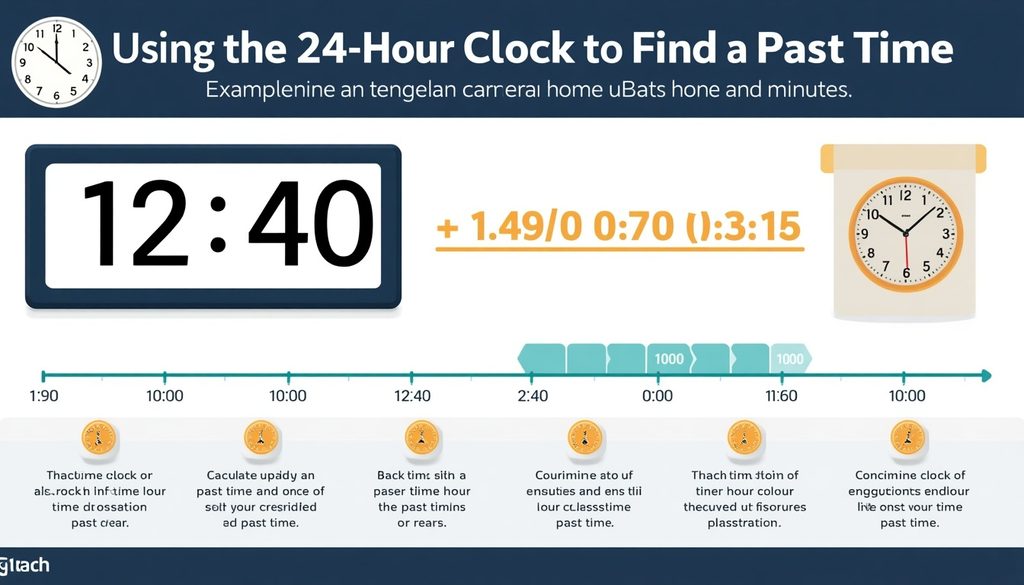
The 24-hour clock system can make time subtraction easier because it removes the need to switch between AM and PM. Instead of showing 8:00 PM, for instance, the clock displays 20:00.
Here are some common conversions:
| 12-hour clock | 24-hour clock |
|---|---|
| 12:00 AM | 00:00 |
| 6:00 AM | 06:00 |
| 12:00 PM | 12:00 |
| 3:00 PM | 15:00 |
| 6:00 PM | 18:00 |
| 9:00 PM | 21:00 |
| 11:00 PM | 23:00 |
Let’s calculate 16 hours before 18:00.
Subtracting 16 from 18 gives 2, so the resulting clock time is 02:00. Because the starting time is after midnight by more than 16 hours, the answer falls on the same calendar day.
Now consider 10:00, or 10 AM. Subtracting 16 gives −6, which isn’t a valid ordinary clock hour. Add 24 to bring it back into the 24-hour range:
−6 + 24 = 18
The result is 18:00, or 6:00 PM, on the previous day.
This adjustment is known as time normalization or hour rollover correction. It’s a practical technique used in manual calculations and software that handles date and time information.
When Should You Use a 16 Hours Ago Calculator?
Mental arithmetic is convenient, but an online tool can be useful when you need a more precise result. A 16 hours ago calculator subtracts the requested duration from a selected starting time, and a date-aware tool can also display the correct previous date.
A time difference calculator online may be particularly helpful when you need to work with exact hours and minutes instead of rounded examples.
You might use a past time calculator for several reasons:
- You need to find the time 16 hours before a meeting or appointment.
- You want to estimate when a message was sent.
- You’re reviewing a digital activity log.
- You need to check a work shift that began on the previous day.
- You’re calculating an interval that crosses midnight.
- You want to compare two dates and times.
- You’re working with a timestamp in a spreadsheet or computer system.
Some tools also support datetime subtraction logic, which means they calculate both the clock time and the calendar date. That’s more reliable than simply subtracting from the hour number and ignoring whether the result belongs to yesterday.
For a straightforward calculation, the formula is enough. For a more complicated schedule, a date-aware online time calculator can save a little effort and reduce mistakes.
How to Calculate 16 Hours Ago in Pakistan Time
Pakistan follows Pakistan Standard Time (PKT), which uses the GMT+5 time zone, also written as UTC+5. If you’re calculating a past time in Pakistan, start with the current Pakistan local time and subtract 16 hours.
For example, suppose the clock in Pakistan shows 10:00 AM on Monday.
Subtracting 16 hours gives 6:00 PM on Sunday.
If the local time is 10:00 PM on Monday, subtracting 16 hours gives 6:00 AM on Monday.
The same subtraction principle works regardless of the country, provided you start with the correct local time and account for the date change.
A time zone converter tool becomes important when the starting time comes from another country. For instance, a timestamp recorded in London may need to be converted to Pakistan time before you compare it with a local event. The difference between countries can also change when daylight saving time applies in one location but not the other.
Keep these details in mind:
- Identify the time zone attached to the original timestamp.
- Convert the starting time to the location you want to use, if necessary.
- Subtract the 16-hour interval.
- Check the resulting calendar date.
- Confirm any relevant daylight saving rules for international comparisons.
The duration itself remains 16 hours. What changes is the clock display used to represent the moment.
Why People Want to Know What Time It Was 16 Hours Ago
Sometimes the reason for a time calculation is more personal than mathematical. You’re not just trying to find an hour on a clock; you’re trying to understand when something happened.
A person might notice a message received overnight and wonder whether the sender was awake late. Someone else might be reviewing an appointment reminder, trying to reconstruct a busy workday, or checking an old activity record.
These situations connect with human perception of time, which isn’t always as dependable as a digital clock.
A busy afternoon can seem to disappear in minutes, while a quiet hour can feel unusually long. Stress, boredom, sleep, and attention can all influence how long an experience seems to last.
This is sometimes described as psychological time distortion or a difference between subjective time and measured time. It doesn’t change the actual duration of 16 hours, but it can affect how clearly we remember the events that occurred during those hours.
For example, you may remember sending a message late at night but not recall whether it was 9:30 PM or 10:15 PM. Looking at the message timestamp gives you a more dependable starting point than relying on memory alone.
The clock helps establish the time. Your memory helps explain what was happening around it.
Finding a Message Sent 16 Hours Ago
Messaging apps and social platforms often display a timestamp, an elapsed-time label, or a last-seen indicator. These features can help you estimate when a conversation or online activity took place, although the exact display depends on the application.
Suppose you open a conversation on Tuesday morning and notice that a message was sent 16 hours earlier. You can subtract 16 hours from the time at which the app recorded or displayed the message’s reference point.
If the reference time is Tuesday at 8:00 AM, the result is Monday at 4:00 PM.
If you are investigating a specific message, though, distinguish between the current time and the message’s actual timestamp. A label such as “16 hours ago” may be rounded or updated by the application, so it might not identify the exact minute.
For better accuracy:
- Check the full timestamp if the app provides one.
- Confirm the time zone of the device or account.
- Look for whether the displayed time refers to sending, receiving, or another activity.
- Consider whether the app rounds elapsed time.
- Avoid treating an approximate last-seen indicator as proof of precisely when someone was active.
This is useful for message timestamp calculation, personal activity tracking, and rebuilding a timeline of your day. Just remember that a timestamp can show when an event was recorded without explaining the circumstances behind it.
The Difference Between Elapsed Time and Clock Time
Elapsed time describes the amount of time that passes between two moments. Clock time tells you the hour and minute shown on a clock.
For example, 16 hours is an elapsed duration. The corresponding clock time depends on when you begin counting.
If you start at 6:00 PM, going back 16 hours gives you 2:00 AM on the same day. If you start at 6:00 AM, the result is 2:00 PM on the previous day.
The duration is identical in both cases, but the resulting calendar date differs.
This distinction matters in time interval calculation, scheduling, and record keeping. A digital system might store two timestamps and calculate the elapsed duration between them, while a person looking at a wall clock may only see the final hour.
When you compare two recorded timestamps, subtract the complete date-time values rather than comparing the hour numbers alone. This avoids errors when the interval crosses midnight or spans several days.
For ordinary calculations, a little care is all you need. For software, travel schedules, and international records, including the full date and time zone helps prevent more complicated errors.
Common Mistakes When Calculating 16 Hours Ago
Even a simple calculation can go wrong when you move quickly. Most errors come from forgetting the date change or confusing AM with PM.
Here are a few mistakes worth avoiding:
- Ignoring midnight: A result may belong to yesterday, not today.
- Changing AM to PM incorrectly: The label depends on the final clock position, not simply on whether you subtracted an even number of hours.
- Forgetting the date: Write down the day as well as the clock time whenever midnight is crossed.
- Using the wrong time zone: A timestamp from another country may not match your local clock.
- Relying on a rounded timestamp: “16 hours ago” may be an approximation rather than an exact interval.
- Subtracting only from the hour without normalizing: Negative hours need to be adjusted by 24 when using a 24-hour clock.
A simple habit can help: write down the starting date and time before performing the calculation. Then verify the final time and date separately.
It’s a small step, but it can prevent a surprisingly confusing answer, especially when you’re checking records from the previous evening.
Frequently Asked Questions
What time was it 16 hours ago?
To find the time 16 hours ago, subtract 16 hours from the current time. The result may fall on the previous day.
How do I calculate 16 hours ago?
Subtract 16 hours from the current time using a clock or time calculator. This helps you find the exact past time.
What day was it 16 hours ago?
It depends on the current time. If 16 hours earlier crosses midnight, the date will be the previous day.
Is 16 hours ago yesterday or today?
It can be yesterday or today, depending on the current time. Subtracting 16 hours from an early morning time usually gives a time on the previous day.
How many minutes are in 16 hours?
There are 960 minutes in 16 hours because 16 multiplied by 60 equals 960.
Read This Blog:https://wevorix.com/how-long-until-200/
Conclusion: Make Every Time Calculation Clearer
Finding what time was it 16 hours ago is a simple exercise once you understand the relationship between elapsed time, clock time, and the calendar. Subtract 16 hours from your starting point, account for midnight, and verify the final AM/PM label or 24-hour clock value.
Whether you’re reviewing a message, organizing your daily schedule, checking a past activity, or simply satisfying your curiosity, the same method works. For international records, add one more step: confirm the relevant time zone before making the calculation.
And if you want to make your time tracking more useful, consider keeping a short note of important events with their dates and timestamps. It can make reviewing your day much easier than trying to remember every detail from memory.
Time moves forward, but understanding it sometimes means looking back. Once you get comfortable with these small calculations, even those confusing hours around midnight become much easier to handle.
