
There is something strangely satisfying about watching a project come together. A garden bed gets filled, a driveway starts looking new, or a concrete patio slowly becomes a real part of the home.
And sometimes, right in the middle of all that excitement, comes the less glamorous question: How much material do I actually need? This is where a Cubic Yard Calculator becomes surprisingly useful.
For a homeowner preparing a backyard, a landscaper planning a large property, or a contractor ordering several loads of gravel, guessing is usually not the friend you want beside you.
A little too much material can eat into the budget, while too little can leave the project sitting awkwardly half-finished. Nobody wants a truck arriving with mountains of mulch when the garden needed a hill, not Everest.
A Cubic Yard Calculator helps turn ordinary measurements into a practical material estimate. By entering dimensions such as length, width, and depth, you can determine the approximate volume of a space and express it in cubic yards.
That simple conversion can make ordering concrete, gravel, mulch, topsoil, sand, or other bulk materials much easier.
And yes, the math can be done by hand. But when you’re holding a measuring tape, standing beside a muddy garden bed, and wondering whether you remembered the decimal correctly, an online calculator starts looking like a very good friend.
| Measurement | Formula |
|---|---|
| Cubic Feet | Length × Width × Depth |
| Cubic Yards | Cubic Feet ÷ 27 |
| 1 Cubic Yard | 27 Cubic Feet |
| 1 Cubic Yard | 46,656 Cubic Inches |
| Common Materials | Soil, Gravel, Sand, Mulch, Concrete |
What Is a Cubic Yard Calculator?
A Cubic Yard Calculator is a type of volume calculator designed to determine how many cubic yards of material are needed to fill a particular space. It is commonly used in construction, landscaping, excavation, gardening, and home improvement projects.
The basic idea is beautifully simple. You measure the space, calculate its volume, and convert that volume into cubic yards. The calculator does the arithmetic, while you get to focus on the actual project, which is probably where your attention belongs anyway.
A yardage calculator may ask for measurements in feet, inches, yards, or other units. Many calculators are especially useful for rectangular areas because the calculation is based on:
V = L × W × D
Here, length, width, and depth are multiplied together to find the volume in cubic feet when the dimensions are measured in feet.
For example, imagine a rectangular area measuring 15 feet long, 7 feet wide, and 8 feet deep. The volume is:
15 × 7 × 8 = 840 cubic feet
Since one cubic yard contains 27 cubic feet, the result is approximately:
840 ÷ 27 = 31.11 cubic yards
That is the basic heart of a CY calculator.
Why Use a Cubic Yard Calculator?
Bulk materials are often sold by the cubic yard, rather than by individual bags or tiny containers. That makes accurate yardage calculation important before placing an order.
A calculator can help homeowners, landscapers, contractors, builders, gardeners, and DIY enthusiasts estimate the amount of material required for a project.
Imagine ordering gravel for a driveway without measuring. You might think, “Eh, this should probably do it.” Famous last words.
Using a cubic yard volume calculator can help you:
- Estimate the amount of material required
- Compare quantities between different project areas
- Prepare a realistic project budget
- Reduce unnecessary material waste
- Avoid serious material shortage
- Make bulk material ordering easier
- Estimate delivery requirements
- Check calculations provided by suppliers
- Plan landscaping and construction work more confidently
It doesn’t remove every uncertainty, of course. Materials can settle, compact, spread differently, or leave small gaps. But an accurate starting calculation is much better than a heroic guess.
How to Calculate Cubic Yards

The standard method for a rectangular area is quite straightforward.
First, measure the length, width, and depth of the space in feet.
Then multiply them:
Volume = Length × Width × Depth
This gives you cubic feet.
Finally, convert cubic feet to cubic yards by dividing by 27:
Cubic yards = Cubic feet ÷ 27
The reason for 27 is simple:
1 cubic yard = 27 cubic feet
Because one yard equals three feet, a cubic yard is:
3 × 3 × 3 = 27 cubic feet
So if your project has a volume of 270 cubic feet:
270 ÷ 27 = 10 cubic yards
That means you need approximately 10 cubic yards before considering extra material for settling, compaction, or material loss.
Cubic Yard Conversion Made Simple
Cubic yard conversion becomes easier when you remember a few useful numbers.
1 cubic yard = 27 cubic feet
1 cubic yard = 46,656 cubic inches
1 cubic yard ≈ 0.7646 cubic meters
These relationships are useful when measurements come from different sources.
For example, if a supplier tells you that a truck contains 10 cubic yards, you can convert that into cubic feet by multiplying by 27:
10 × 27 = 270 cubic feet
So 10 cubic yards is equal to 270 cubic feet.
For cubic feet to cubic yards, divide by 27. For cubic yards to cubic feet, multiply by 27. Thats really the main trick.
Using Inches in a Cubic Yard Calculation
Sometimes the dimensions of a project are measured in inches rather than feet. This happens often with smaller areas, slabs, boxes, or detailed construction measurements.
Before calculating volume in cubic yards, convert inches into feet.
For example:
6 inches = 0.5 feet
3 inches = 0.25 feet
Suppose you have a concrete slab that is 20 feet long and 10 feet wide with a depth of 6 inches.
Convert 6 inches:
6 ÷ 12 = 0.5 feet
Then calculate:
20 × 10 × 0.5 = 100 cubic feet
Now convert to cubic yards:
100 ÷ 27 ≈ 3.70 cubic yards
So the project requires approximately 3.70 cubic yards of concrete before adding any practical allowance.
This is one reason an online cubic yard calculator can be handy. Tiny unit mistakes can quietly become large quantity mistakes.
Cubic Yard Calculator for Landscaping

Landscaping is one of the places where a landscaping calculator earns its keep.
Garden beds, pathways, decorative areas, lawns, and planting zones frequently require bulk materials such as mulch, topsoil, compost, gravel, and decorative rocks.
A gardener might have a rectangular garden bed that is 12 feet long, 5 feet wide, and 0.25 feet deep.
The volume is:
12 × 5 × 0.25 = 15 cubic feet
Then:
15 ÷ 27 ≈ 0.56 cubic yards
So the garden bed needs roughly 0.56 cubic yards of material.
For larger areas, the number grows quickly. Suddenly that innocent-looking flower bed is asking for an entire delivery truck. Gardening can be dramatic like that.
Cubic Yard Calculator for Concrete
Concrete projects often require especially careful volume calculation because concrete is commonly purchased in specific quantities.
A concrete yard calculator can help estimate material requirements for:
- Concrete slabs
- Driveways
- Patios
- Walkways
- Sidewalks
- Foundations
- Footings
- Residential projects
- Commercial projects
For a rectangular slab, the familiar formula applies:
V = L × W × D
If the measurements are in feet, the result is in cubic feet. Divide by 27 to convert the answer to cubic yards.
For irregular slabs, the area can be divided into smaller rectangular sections. Each section can be calculated separately and then added together. It is less exciting than pretending the whole shape is a rectangle, but much more reliable.
Cubic Yard Calculator for Gravel
Gravel is used for driveways, drainage areas, pathways, landscaping, and construction.
A gravel yard calculator works by determining the volume of the area and converting it into cubic yards.
Suppose a gravel driveway is 50 feet long, 10 feet wide, and 0.5 feet deep:
50 × 10 × 0.5 = 250 cubic feet
Then:
250 ÷ 27 ≈ 9.26 cubic yards
So the basic estimate is about 9.26 cubic yards.
However, gravel can compact after installation. The final order may therefore need an extra material allowance, depending on the project and the supplier’s recommendations.
Cubic Yard Calculator for Mulch and Topsoil

Mulch and topsoil are often measured by depth across a large surface area.
This makes the mulch calculator, topsoil calculator, and general material calculator particularly useful.
A shallow layer can still require a surprisingly large amount of material because the surface area may be huge.
For example, a 1,000-square-foot garden area covered with 3 inches of material requires converting 3 inches to feet:
3 inches = 0.25 feet
Then:
1,000 × 0.25 = 250 cubic feet
And:
250 ÷ 27 ≈ 9.26 cubic yards
So roughly 9.26 cubic yards would cover the area mathematically.
Actual coverage can vary because of settling, uneven ground, spreading methods, and the condition of the surface.
Different Shapes Need Different Volume Formulas
Not every project is a simple rectangular box. Real spaces have curves, slopes, pipes, tanks, and all sorts of shapes that seem designed specifically to annoy your measuring tape.
For a box or rectangular area:
V = L × W × D
For a cube:
V = a³
For a cylinder:
V = πr²h
For a cone:
V = 1/3πr²h
For a pyramid:
V = 1/3Bh
For a hemisphere:
V = 2/3πr³
A calculator that supports multiple geometric shapes can therefore be more flexible than a basic rectangular volume tool.
Hollow Shapes
Some projects involve hollow structures where both outer dimensions and inner dimensions matter.
For a hollow cylinder, for example, calculate the outer volume and subtract the inner volume:
Material volume = Outer volume Inner volume
The same general concept applies to hollow cuboids and rectangular tubes.
This is useful when calculating material in pipes, walls, containers, and other structures where the empty interior should not be counted.
Common Materials Measured in Cubic Yards
A material quantity calculator can be used for many bulk materials.
Concrete
Used for slabs, foundations, driveways, patios, sidewalks, and structural work.
Gravel
Commonly used for driveways, drainage, pathways, and landscaping.
Mulch
Used around trees, shrubs, flower beds, and garden areas.
Topsoil
Useful for lawns, raised beds, planting areas, and soil replacement.
Sand
Used in construction, landscaping, leveling, and other applications.
Crushed Stone
Frequently used for foundations, drainage, roads, and hardscape projects.
Compost
Often used to improve garden soil and planting beds.
Fill Dirt
Useful for grading, leveling, excavation backfill, and raising low areas.
Each material behaves differently. Weight, moisture, settling, compaction, and density can vary, so volume alone doesn’t always tell the entire purchasing story.
How Much Material Do You Actually Need?

The question “how many cubic yards do I need?” sounds simple, but the answer depends on the dimensions and type of project.
Start by measuring the space accurately.
Then determine:
- Length
- Width
- Depth
- Shape
- Unit of measurement
- Material type
- Expected settling
- Expected compaction
- Potential material loss
For many projects, people allow approximately 5 10% extra material as a practical buffer. The exact amount depends on the material and project conditions, so supplier guidance should be considered before ordering.
For example, if your calculation says 10 cubic yards, adding 5% means:
10 × 1.05 = 10.5 cubic yards
A 10% allowance would give:
10 × 1.10 = 11 cubic yards
The extra isn’t automatically necessary for every job, but it can help account for real-world conditions.
How a Cubic Yard Calculator Helps With Project Costs
A volume estimate becomes much more useful when combined with pricing.
If a supplier charges a particular price per cubic yard, you can estimate:
Material cost = Cubic yards × Price per cubic yard
Suppose a project requires 8 cubic yards and the material costs $40 per cubic yard:
8 × $40 = $320
This doesn’t necessarily represent the complete project cost, because delivery, labor, equipment, taxes, site preparation, and other expenses may apply.
Still, the quantity estimate gives you a useful starting point for the budget.
For homeowners especially, this can make comparing different project approaches easier. You can estimate material requirements before calling suppliers instead of discovering the quantity after the phone call has already started.
Common Mistakes When Calculating Cubic Yards
Even simple volume calculations can go sideways.
One common mistake is forgetting that depth must be converted into the same unit as length and width. If the area is measured in feet but the depth is entered as 6 instead of 0.5 for six inches, the result will be wildly different.
Another mistake is confusing square feet with cubic feet. Square feet describe area. Cubic feet describe volume. The moment depth enters the calculation, you’re no longer dealing with area alone.
People also sometimes multiply by 27 when they should divide by 27.
Remember:
Cubic feet → cubic yards: divide by 27
Cubic yards → cubic feet: multiply by 27
And perhaps the sneakiest mistake of all is measuring only one section of an irregular project and assuming the rest is “about the same.” Soil and concrete are not famous for respecting optimism.
Cubic Yard Calculator for Different Projects

A single construction calculator can support many types of work.
For a driveway, use a driveway material calculator to estimate gravel or concrete.
For a patio, use a patio material calculator to estimate the required base or concrete.
For excavation, an excavation volume calculator can help estimate how much soil or fill material must be removed or replaced.
For a garden, a garden bed calculator can estimate soil, compost, or mulch.
For raised planters, measure the inside dimensions because the material fills the interior space.
For foundations, divide complex shapes into manageable sections and calculate each one separately.
This approach is especially useful for large residential projects, commercial projects, and professional construction work where a small measurement error can become a large quantity difference.
Understanding Material Coverage
People often ask, “how many square feet does one cubic yard cover?”
There isn’t one universal answer because coverage depends on the depth of the material.
One cubic yard equals 27 cubic feet. If spread 3 inches deep, for example, the coverage will be different from spreading the same cubic yard 6 inches deep.
Since:
3 inches = 0.25 feet
A cubic yard contains 27 cubic feet, so at 3 inches deep:
27 ÷ 0.25 = 108 square feet
Therefore, one cubic yard theoretically covers about 108 square feet at a depth of 3 inches.
Actual coverage can vary due to uneven surfaces, compaction, material characteristics, and installation practices.
Who Can Benefit From a Cubic Yard Calculator?
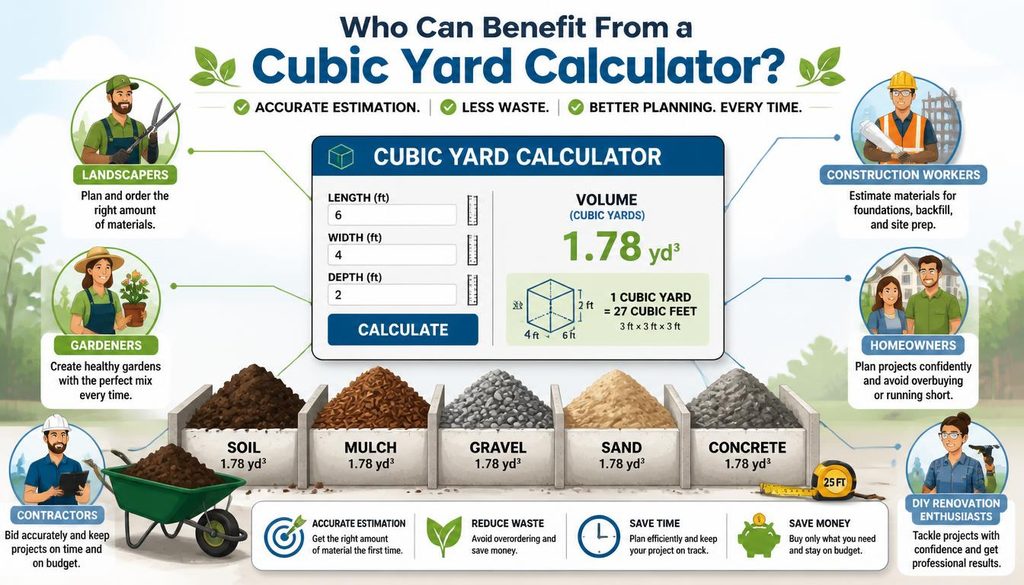
A Cubic Yard Calculator isn’t just for construction professionals.
Homeowners can use it for backyard improvements.
Landscapers can estimate mulch, soil, gravel, and decorative stone.
Contractors can prepare material estimates.
Builders can estimate concrete and fill material.
Gardeners can calculate soil and compost.
Engineers can use volume calculations as part of larger project planning.
Construction estimators can use yardage calculations when preparing project quantities.
Even a DIY enthusiast working on a Saturday morning can benefit. Especially the DIY enthusiast who has already made three trips to the hardware store and has decided there will be no fourth trip, thank you very much.
Tips for More Accurate Yardage Calculation
Good measurements create better estimates.
Measure the project in several places when the ground isn’t perfectly level. For irregular areas, divide the space into smaller sections. Keep all measurements in consistent units before calculating.
Record the measurements instead of trying to remember them.
If possible, double-check your depth. A difference between 3 inches and 4 inches can make a meaningful difference over a large surface.
Also consider settling, compaction, and material loss. Soil, gravel, mulch, and similar materials don’t always remain exactly where you first spread them.
For major construction work, professional specifications and supplier recommendations should take priority over a basic online estimate.
Frequently Asked Questions
How Does a Cubic Yard Calculator Work?
A Cubic Yard Calculator uses length, width, and depth to calculate the total volume in cubic yards.
How Many Cubic Feet Are in a Cubic Yard?
One cubic yard equals 27 cubic feet, so divide cubic feet by 27 to get cubic yards.
What Measurements Do I Need?
You typically need the length, width, and depth of the area you want to calculate.
Can I Use the Calculator for Soil and Gravel?
Yes, you can use it to estimate quantities for soil, gravel, mulch, sand, and other materials.
How Do I Calculate Cubic Yards Manually?
Multiply length × width × depth in feet, then divide the result by 27 to find cubic yards.
Read This Blog:https://wevorix.com/email-generator/
Final Thoughts on Using a Cubic Yard Calculator
A Cubic Yard Calculator turns an otherwise messy question into something measurable. Length, width, depth, shape, and material become numbers that can be understood, checked, and used for planning.
Whether you’re trying to figure out how to calculate cubic yards for a driveway, estimating concrete for a patio, planning mulch for a garden bed, or working out how much gravel belongs beneath a new pathway, the basic principle remains the same: determine the volume, convert the units, and account for real world conditions.
The magic number worth remembering is 27.
1 cubic yard = 27 cubic feet.
Divide cubic feet by 27 when converting to cubic yards. Multiply cubic yards by 27 when converting back to cubic feet.
It may not have the emotional sparkle of welcoming a newborn daughter into a family, but there is its own little kind of joy in seeing a confusing pile of measurements suddenly become a clear material estimate.
A garden becomes a plan. A driveway becomes a quantity. A construction project becomes something you can actually budget for.
And perhaps that is what a useful calculator really does: it takes a problem that feels bigger than it should and quietly makes it manageable.
Before ordering your material, check your dimensions one more time, review the supplier’s recommendations, consider 5 10% extra material where appropriate, and keep your calculations somewhere easy to find.
Your future self, probably standing beside a truck full of gravel, will be rather grateful.
