
There is something strangely emotional about building a Subwoofer from scratch. You cut the wood, measure the panels twice, stare at the driver like it has personally offended your measuring tape, and then finally hear that first deep note coming from a box you made yourself.
It feels a little like welcoming something new into the family, honestly. A DIY speaker can sit quietly in a workshop for days, but when it finally produces clean bass, suddenly the whole room feels different.
The same feeling happens when a family welcomes a baby girl. A tiny new person arrives, and suddenly ordinary things seem important. A quiet room, a little blanket, a sleepy smile, the first congratulations from grandparents.
Building a speaker isn’t remotely the same as raising a child, of course, but both can teach us that small details matter more than we expect.
That is also exactly why a Subwoofer Vent Calculator is useful. The port may look like just a hole in a subwoofer box, but its dimensions influence how the enclosure behaves.
Port diameter, port length, enclosure volume, and tuning frequency all work together. Get them reasonably right, and your bass response can become deep, controlled, and enjoyable. Get them wrong, and the box might make more noise than the music.
| Parameter | Description |
|---|---|
| Enclosure Volume | Internal air space of the subwoofer box |
| Tuning Frequency | Desired resonant frequency (Hz) |
| Port Width | Width of the vent opening |
| Port Height | Height of the vent opening |
| Port Length | Required length of the vent |
| Port Area | Total cross-sectional area of the port |
| Main Purpose | Calculate port dimensions for accurate bass tuning |
What Is a Subwoofer Vent / Port Calculator?
A Subwoofer Port Calculator is a design tool used to estimate the dimensions of a vent or port in a ported enclosure. Its main job is usually calculating port length from the enclosure volume, desired tuning frequency, port diameter, and number of ports.
A good calculator may also estimate the minimum port diameter required to keep port air velocity within a practical range. That matters because air moving too quickly through a narrow opening can become turbulent, producing audible port noise, commonly called chuffing.
The idea comes from the behavior of a Helmholtz resonator. In a bass-reflex system, the air inside the port acts somewhat like an acoustic mass while the air volume inside the cabinet acts like an acoustic spring. Together, they create Helmholtz resonance at a particular frequency.
That sounds very scientific, and it is, but the practical idea is simple: the port helps the enclosure produce useful low-frequency output around its selected tuning point.
Why Port Design Matters So Much
Imagine two otherwise similar subwoofer boxes. One has a carefully selected port diameter and length, while the other has a tiny vent chosen because it happened to fit the available piece of PVC.
They may both produce bass, but they won’t necessarily behave alike.
A properly designed subwoofer vent can help extend the useful low-frequency response of a bass-reflex enclosure.
An undersized port, meanwhile, can create high air velocity and unwanted turbulence. A badly calculated port can also produce a tuning frequency different from what the builder expected.
This becomes especially noticeable in car audio, home theater, pro audio, and studio monitoring, where different goals may require different enclosure choices.
For example, a home theater system may prioritize deep bass and LFE extension, while an SPL competition build might prioritize enormous output around a narrower frequency range. A music-oriented system may instead aim for balanced musical bass rather than maximum pressure.
Subwoofer Port Calculator: The Basic Formula

A commonly used port length formula for a round vent can be expressed as:
Lv = (23562.5 × Dv² × Np) / (Vb × fb²) − k × Dv
Here:
- Lv = physical port length
- Dv = port diameter
- Np = number of ports
- Vb = enclosure volume
- fb = desired tuning frequency
- k = end correction factor
- 23562.5 = commonly used calculation constant
The exact implementation can vary depending on the calculator and assumptions about the port geometry, so don’t treat one formula as some sacred wooden tablet from the speaker gods.
The important relationship is easier to remember than the entire equation: increasing port length generally lowers the tuning frequency, while increasing port diameter generally requires a longer port to maintain the same tuning.
That relationship becomes extremely useful when designing a DIY subwoofer.
Understanding the Variables Before You Build
The symbols can look intimidating for about thirty seconds. After that, they are mostly just labels.
Lv Port Length
Lv represents the calculated port length. It may be given in centimeter (cm), millimeter (mm), meter (m), inch (in), or another unit depending on the calculator.
If your calculator says the required length is 32 cm, don’t casually build 25 cm because the leftover wood looked nicer that way. That change can affect the final tuning.
Dv Port Diameter
Dv is the internal diameter of a round port.
Common examples include 4 cm, 7.62 cm / 3 inches, and 10 cm / approximately 4 inches. Larger ports generally allow more air to pass with lower velocity, but they also require more physical space and often greater length.
Np Number of Ports
Np means the number of ports. A box could have one large port, two smaller ports, or several openings.
Multiple ports should be treated as a complete acoustic system rather than simply drilling extra holes wherever there is empty space.
Vb Enclosure Volume
Vb represents the effective enclosure volume used in the calculation. This is usually related to net box volume, not simply the outside dimensions of the cabinet.
A builder should account for the volume occupied by the speaker driver, port, bracing, and other internal structures.
fb Tuning Frequency
fb is the desired port tuning frequency.
Common targets might include 25 Hz, 32 Hz, 35 Hz, 45 Hz, or 60 Hz, depending on the enclosure and application.
Lower tuning can support lower-frequency extension, but it does not automatically mean “better bass.” Audio design is rarely that polite.
Minimum Port Diameter and Air Velocity
The minimum port diameter formula is important because a mathematically correct port can still be physically impractical.
A small port has less port cross-sectional area, which means the same amount of displaced air has to travel through a smaller opening. As velocity increases, airflow can become turbulent.
Many designers use a target around 17–20 m/s peak air velocity as a practical reference, although the appropriate limit depends on the design and application.
The calculation often considers:
- Sd cone area
- Xmax peak excursion
- Vd driver displacement volume
- number of ports
- tuning frequency
- port cross sectional area
A high-excursion driver can move a surprisingly large amount of air. If the port isn’t large enough, the air can start behaving less like smooth airflow and more like a tiny angry weather system.
That is where port chuffing becomes noticeable.
How End Correction Changes Port Length
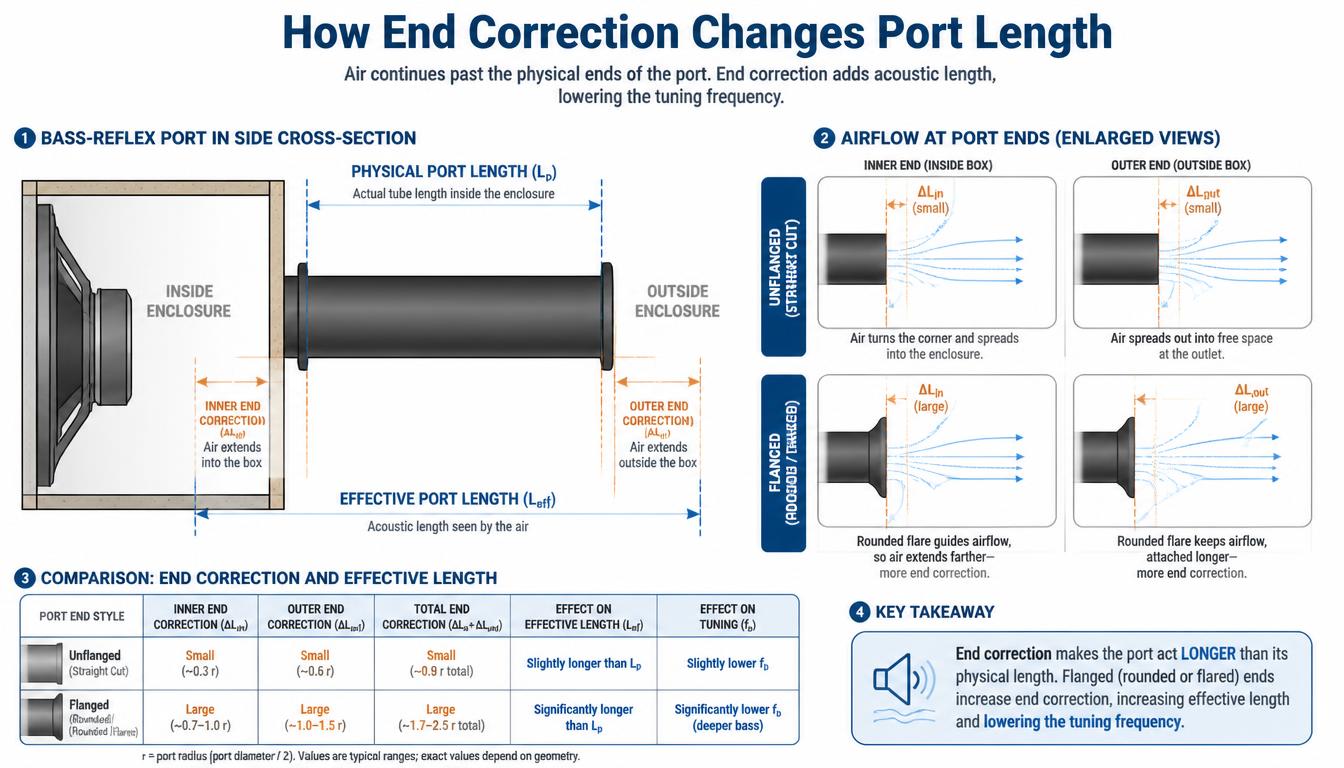
One of the more interesting details in port design is end correction.
The air doesn’t stop moving exactly at the physical edge of a port. The surrounding air also participates in the acoustic behavior. This makes the effective acoustic length somewhat different from the measured physical length.
Depending on the geometry, different values such as 0.614, 0.732, or 0.850 may appear as an end correction factor in calculations.
A free port end, flanged opening, port mounted near a wall, or other geometry can change the effective acoustic behavior.
This is why the physical port length should not always be interpreted as the entire acoustic length. It is one reason calculators make assumptions that may need to be adjusted for real-world construction.
Round Port, Slot Port, or PVC Tube Port?
There isn’t one universal port shape for every enclosure.
A round port is convenient, compact, and often easy to construct. A PVC tube port is particularly popular among DIY builders because PVC pipe is easy to find and modify.
A slot port, on the other hand, can become part of the cabinet itself. A rectangular opening can be built into the front or rear panel and shaped according to the available space.
Other designs include:
- Rectangular port
- Flanged port
- Free-end port
- Dual port
- Multiple-port arrangements
For rectangular vents, the hydraulic diameter or equivalent diameter can help translate the port’s cross-sectional area into a form usable by certain calculations.
A slot port calculator therefore may not ask for a simple diameter. Instead, it may require width and height.
Ported Enclosure vs Sealed Enclosure
A ported enclosure and a sealed enclosure behave differently.
A sealed enclosure has no intentionally tuned vent. The air trapped inside acts as part of the suspension system for the driver.
A bass-reflex enclosure, meanwhile, uses a port to create an additional resonant system. Properly designed, it can provide greater output or useful bass extension around the tuning region.
There are also bandpass enclosure designs, which use more complicated chamber arrangements and can be particularly sensitive to design choices.
So before reaching for a subwoofer port calculator, first make sure you actually want a ported design. Otherwise you’re calculating a hole for a box that didn’t ask for one.
Subwoofer Box Volume: Gross vs Net

One of the easiest mistakes in subwoofer box design is confusing gross enclosure volume with net enclosure volume.
Suppose a cabinet measures a certain external size. That does not mean all of that space is available for air.
You may have:
- Driver displacement
- Port displacement
- Bracing
- Internal panels
- Other structural components
The result is the net enclosure volume.
For example, a theoretical enclosure might begin around 50 liters or 90 liters, but its usable acoustic volume could be smaller after internal components are included.
Even a 2 liters difference can matter in a compact design, especially when combined with a low tuning frequency.
A Practical Port Calculation Example
Suppose a builder is designing a ported enclosure with a selected net volume, a round port, and a target tuning around 35 Hz.
The builder enters the desired:
- Vb
- Dv
- Np
- fb
into the subwoofer port length calculator.
The calculator produces a starting value for Lv.
The builder then checks whether the selected diameter provides acceptable port air velocity at the driver’s expected peak excursion.
This second check is important. A port length calculation alone doesn’t guarantee good airflow.
The design should also account for the driver’s Thiele-Small parameters, especially Fs, Sd, and Xmax.
Thiele-Small Parameters and Subwoofer Design
A serious speaker design usually begins with the driver rather than the cabinet.
Important Thiele-Small parameters can include:
- Fs, or free-air resonance
- Vas
- Qts
- Sd
- Xmax
- Re
- impedance-related characteristics
These values describe how the speaker driver behaves mechanically and electrically.
A driver with substantial cone displacement can move more air and therefore may require a larger port to keep airflow under control.
That is why simply asking, “What port length gives the best bass response?” doesn’t have one universal answer. The answer depends on the driver, enclosure, desired tuning, and application.
How Box Volume Affects Port Tuning
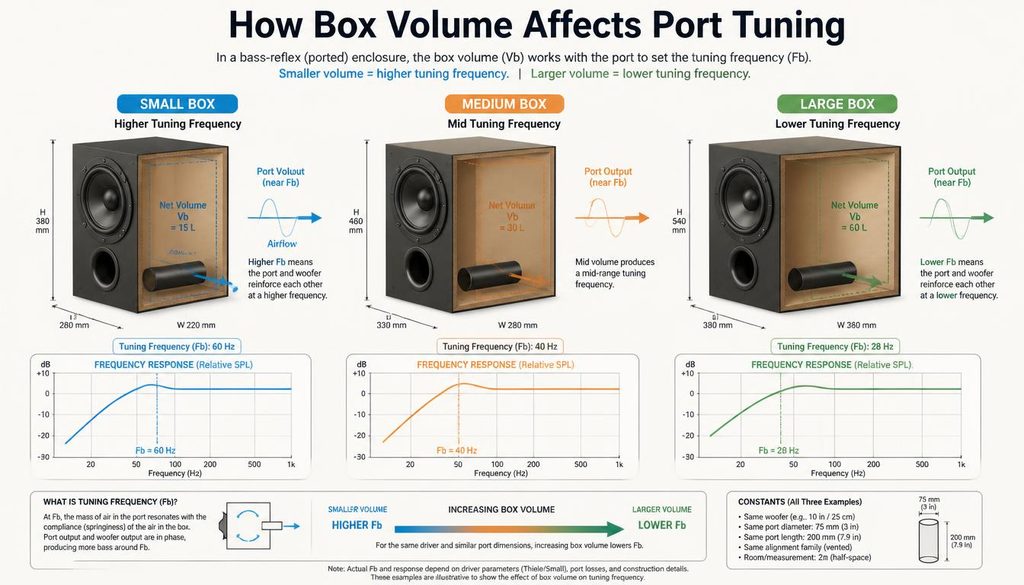
Changing enclosure volume changes the relationship between the air inside the cabinet and the port.
A larger box can require a different port length to achieve the same tuning frequency. A smaller enclosure can require a shorter or longer vent depending on the selected diameter and target frequency.
This is also why changing the internal volume after calculating the port isn’t a tiny cosmetic change.
If you add thick bracing, change the port dimensions, install a larger driver, or alter the internal shape, the acoustic system has changed.
In other words, don’t finish the cabinet first and then announce, “Oh yeah, I forgot to account for the port.”
How Port Diameter Affects Bass Response
Increasing subwoofer port diameter generally increases the available cross-sectional area and can reduce air velocity.
But the tradeoff is space.
A large port can become surprisingly long when the desired tuning frequency is low. A 10 cm / approximately 4 inches port may need considerably more physical space than a smaller opening when both are intended to tune the same enclosure.
Sometimes the port must be folded, flared, or redesigned to fit inside the cabinet.
This is one of those moments when cabinet design and acoustic design stop being separate subjects.
Preventing Port Chuffing
If you hear a breathy, rushing, or fluttering sound from the vent during loud bass passages, you may be hearing port noise or chuffing.
Potential causes include:
- Port diameter is too small
- Air velocity is too high
- Sharp port edges
- Poorly shaped entrances
- Insufficient flaring
- Excessive driver excursion
- Turbulent airflow
A flanged port can help smooth the airflow at the opening. Rounded edges can also reduce abrupt airflow changes.
The goal is not simply to make the hole bigger. It is to create a port that lets air move efficiently without unnecessary turbulence.
Measuring Actual Port Tuning
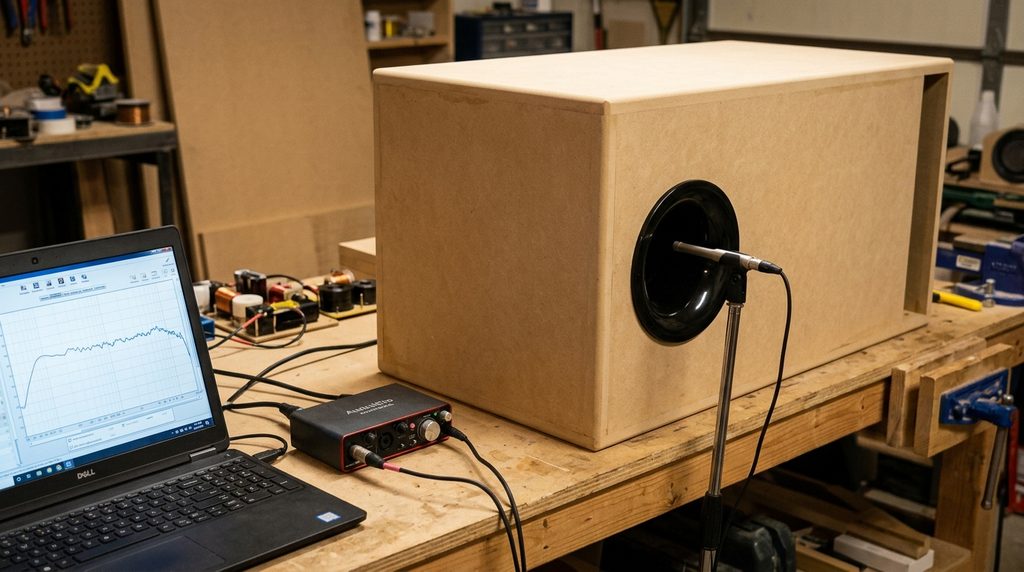
A calculator gives you a theoretical starting point. Real cabinets have real-world imperfections.
Wood thickness can vary. Port dimensions may be slightly different. Bracing changes the volume. A port may sit too close to an internal wall. Construction tolerances can add up.
You can measure actual tuning using tools such as DATS for impedance measurements or a calibrated microphone such as a UMIK 1, depending on your measurement setup and software.
An impedance curve can help identify the behavior of a bass-reflex system and estimate the actual tuning frequency.
This is especially useful for advanced DIY speaker building, where the difference between “calculated” and “measured” becomes part of the learning process.
Subwoofer Vent Calculator for Car Audio
In car audio, enclosure dimensions are often limited by the trunk, rear seats, spare-tire compartment, or available installation space.
A car audio subwoofer may therefore require a compact port arrangement.
A trunk subwoofer box might use a slot port along the cabinet wall. A spare-tire subwoofer may use a carefully positioned round port or another compact vent arrangement.
The same acoustic principles still apply, even though the physical environment is different.
Vehicle cabin gain can also influence perceived bass extension, meaning the tuning decision should consider the actual installation rather than only the box sitting on a workbench.
Subwoofer Vent Calculator for Home Theater
A home theater subwoofer often has different priorities.
Movie soundtracks can contain powerful LFE information, including very low-frequency effects. A properly tuned home theater subwoofer enclosure can therefore be designed around the desired low-frequency response and available amplifier power.
For instance, a design aimed around 25 Hz behaves differently from one tuned around 45 Hz.
But lower isn’t automatically superior. A very low tuning frequency can require a large enclosure, long port, or substantial port area.
Sometimes the practical answer is a balanced compromise rather than chasing one impressive number.
Port Tuning for Music and Pro Audio
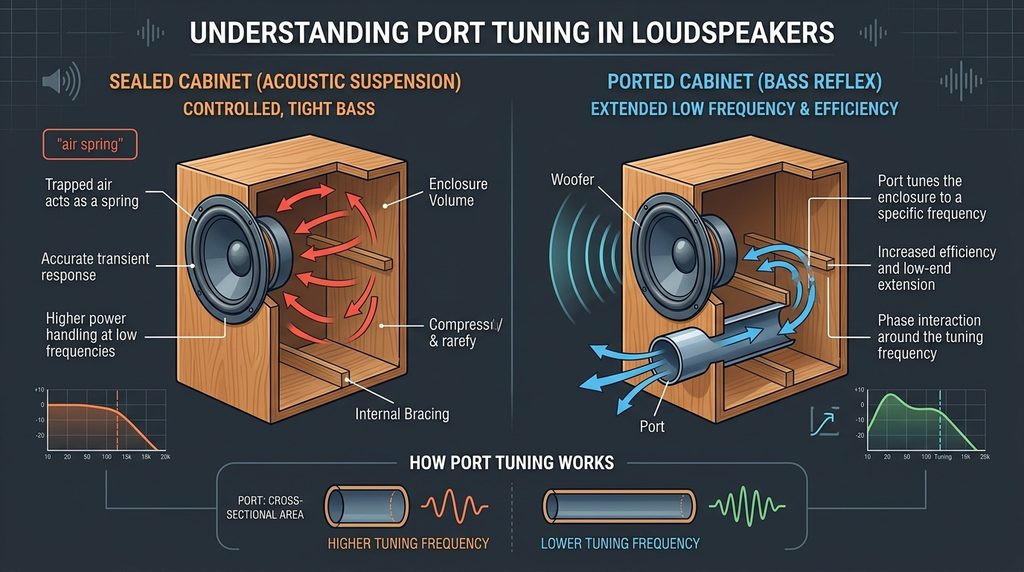
Musical bass tuning can place different demands on an enclosure than movie playback.
Kick drums, electric bass, electronic music, pipe-organ fundamentals, and live concert material all contain different frequency distributions.
In pro audio, a designer may prioritize output, reliability, controlled excursion, and predictable response. A concert sound system might use multiple large enclosures where port geometry becomes a serious engineering consideration.
In studio monitoring, accuracy matters strongly because exaggerated bass can make mixing decisions misleading.
The best design therefore depends on what the system is supposed to do.
Baby Girl Congratulations Messages With a Subwoofer Theme
Now for the wonderfully strange part of our journey. Since every celebration needs a message, here are some baby-girl congratulations lines with a tiny audio-inspired twist. Don’t use all of them at a christening unless the family is extremely into bass.
- Congratulations on your beautiful baby girl! May her little laugh become the sweetest sound in your home.
- A precious daughter has arrived, and suddenly the whole house has a brand-new frequency of happiness.
- Wishing your family endless cuddles, sleepy smiles, and enough joy to shake the walls.
- Your little girl has entered the world, and life just received its most beautiful bass drop.
- May every tiny giggle become a memory you replay forever.
- Congratulations on welcoming your daughter; may her childhood be filled with music, kindness, laughter, and love.
- A baby girl brings a kind of happiness no Subwoofer could ever reproduce.
- May your new daughter fill your home with a deeper kind of happiness than any speaker system can create.
Subwoofer Port Calculator Wishes for New Parents
The next set works nicely for someone who loves DIY audio and has just welcomed a daughter. They’re intentionally playful, because sometimes congratulations don’t need to wear a serious suit.
- Congratulations on your baby girl! May your home always have clean sound, deep laughter, and absolutely no mysterious rattling noises.
- Your new little girl has arrived, and she’s already the most important upgrade your family could ever receive.
- May her smiles be loud, her naps be peaceful, and your subwoofer port never start chuffing during bedtime.
- Wishing your family a lifetime of beautiful moments, perfectly tuned like a carefully built bass-reflex enclosure.
- May every birthday hit harder than the last, in the nicest possible way.
- Your daughter is here! Forget the calculator for a moment and enjoy the greatest addition to the family.
- May your home be filled with love, music, and enough quiet moments for everyone to actually sleep.
- Congratulations on your precious girl. Some things are worth more than perfect port tuning, and this is definitely one of them.
Heartfelt Newborn Blessings for a Baby Girl

Across many cultures, the arrival of a newborn is marked with prayers, family gatherings, gifts, shared meals, and words of blessing. The exact tradition differs from family to family, but the emotional idea is wonderfully similar: everyone pauses for a moment to welcome a new life.
- May your baby girl grow surrounded by people who make her feel safe, valued, and deeply loved.
- May every year bring her new reasons to smile and every difficult day bring someone kind beside her.
- May her childhood be gentle, curious, adventurous, and wonderfully imperfect.
- Wishing your daughter a life filled with meaningful friendships and beautiful memories.
- May your family discover new happiness in all the tiny everyday moments.
- May her first steps, first words, first school day, and every milestone become cherished memories.
- May she grow with confidence while always knowing she has a loving place to return to.
- May your daughter’s arrival bring peace, laughter, and a whole new chapter to your family story.
Funny Messages for Parents Who Love DIY Speaker Building
Parents who spend weekends doing DIY speaker building may appreciate congratulations that don’t sound like every greeting card on the supermarket shelf.
- Congratulations! Your newest project has arrived, and thankfully she doesn’t require a port calculator.
- You’ve successfully completed the most important build of your life, and there are no instructions included.
- New baby, new schedule, zero sleep. At least your speaker measurements can wait.
- Your daughter has arrived, and she already has more personality than your entire speaker cabinet design.
- Forget Xmax and Sd for today. The only measurement that matters is how tiny those baby socks are.
- May your parenting journey have fewer unexpected noises than a badly designed port.
- Congratulations on the new arrival! She is small, adorable, and probably louder than your subwoofer when hungry.
- Your house now has a brand-new sound system: one tiny baby with unlimited volume settings.
Poetic Wishes for Welcoming a Daughter
Some families prefer something softer and more poetic. A newborn message doesn’t have to be complicated to feel sincere.
- A little girl has arrived, bringing a new rhythm to your family’s story.
- Her tiny hands have opened a giant door into a new kind of love.
- May her laughter become one of the sounds your heart remembers longest.
- Today your family became a little bigger, but your world became much bigger too.
- May her dreams be wide, her heart be kind, and her journey be full of wonder.
- A daughter is a new chapter written in very small fingers and very large hopes.
- May the quiet moments with her become the memories you treasure most.
- Welcome, little one. Your family has been waiting for your beautiful little sound.
How to Choose the Right Subwoofer Port Design
Back to the engineering bench, because somebody has to eventually finish the enclosure.
Start with the driver’s Thiele-Small parameters. Establish the desired net box volume and select an appropriate tuning frequency. Then determine the required port cross-sectional area.
After that, calculate the required port length.
If the resulting port is too long to fit, don’t simply cut it shorter and hope for magic. Consider increasing the diameter, changing the number of ports, changing the enclosure dimensions, or reconsidering the tuning frequency.
For a slot port, calculate its area and consider the equivalent diameter or hydraulic diameter where appropriate.
Then account for physical placement, flaring, port walls, and internal clearances.
What Happens If a Subwoofer Port Is Too Small?
A port that is too small can produce excessive port air velocity.
At moderate listening levels you might hear nothing unusual. Turn the amplifier up, however, and the airflow can become increasingly turbulent.
The result can include:
- Chuffing
- Airflow noise
- Reduced efficiency
- Audible turbulence
- Compression at high output
This is especially important for a high-excursion driver, because the driver may move a lot of air.
A large driver does not automatically require one specific port size, but its displacement capability should absolutely be considered.
How to Tune a Subwoofer Port Accurately
A sensible process looks something like this:
First, select the driver and examine its specifications.
Second, choose the enclosure volume.
Third, decide on the target port tuning frequency.
Fourth, calculate port dimensions.
Fifth, check port air velocity.
Sixth, physically build the enclosure while accounting for all internal displacement.
Finally, measure the completed system when practical.
If the measured tuning is slightly different from the theoretical value, investigate the physical dimensions and assumptions before randomly changing things.
A little patience here saves a surprising amount of plywood.
Common Port Design Mistakes

One mistake is using gross box dimensions as if they were net acoustic volume.
Another is forgetting the displacement of a large driver.
Some builders calculate the port before deciding where the port will physically go. Then they discover that their beautifully calculated 1-meter vent has nowhere to live.
Other mistakes include ignoring air velocity, placing the port opening too close to an internal wall, failing to account for end correction, and changing the port length without recalculating the tuning.
The calculator is useful, but it isn’t a substitute for understanding the system.
Choosing the Right Tuning Frequency
There is no universal “perfect” tuning frequency.
A system designed for deep movie effects may target a different region than a compact music system.
A car audio installation may account for cabin acoustics. A studio monitor may prioritize a predictable response. An SPL enclosure may be designed around a very different objective.
Think about the content you actually want to reproduce.
If you mostly listen to music, pay attention to musical bass, transient behavior, and overall frequency response. If your system is primarily for movies, LFE extension may become a larger part of the design conversation.
The frequency number should serve the system, not become the system.
Practical Port Measurements and Units
Port calculations commonly involve:
- Centimeter (cm)
- Millimeter (mm)
- Meter (m)
- Inch (in)
- Foot (ft)
- Liter (L)
- Cubic foot
- Cubic inch
- Hertz (Hz)
- Meters per second (m/s)
For example, 15 mm is a relatively small physical dimension, while 7.62 cm / 3 inches is a common way of describing a round port diameter.
Always make sure your calculator uses compatible units. Mixing liters with cubic feet without conversion is a spectacularly boring way to ruin an otherwise exciting build.
How to Make Your Own Congratulations Message More Personal

The best baby-girl congratulations message usually contains one small detail that belongs only to that family.
Mention the baby’s name if the parents have shared it. Mention the grandparents. Mention the moment you heard the news. If the parents love car audio, home theater, or DIY speaker building, a playful audio reference can make the message feel genuinely theirs rather than copied from a greeting-card website.
For example, instead of writing only “Congratulations on your baby girl,” you could mention that their home has just gained its most important new source of happiness.
That tiny detail changes the message.
Creative Ways to Deliver Your Newborn Wishes
A message can arrive in a text, card, voice note, social post, handwritten letter, or even a small gift tag.
For close family, a handwritten note can feel especially meaningful because parents often keep those little pieces of paper long after the newborn stage disappears.
For someone who loves technology, a digital card or personalized graphic can work beautifully. And if the parents are audio enthusiasts, well, you could make the joke even more ridiculous and say the baby has officially become the highest-priority upgrade in the house.
Just keep the humor warm. New parents are usually tired enough already.
Freuquently Asked Questions
What Is a Subwoofer Vent / Port Calculator?
A Subwoofer Vent / Port Calculator helps determine the ideal port dimensions for a bass-reflex subwoofer enclosure.
Why Is Subwoofer Port Size Important?
The correct port size helps achieve proper airflow, bass response, and tuning frequency while reducing unwanted port noise.
How Do I Calculate Subwoofer Port Length?
Enter your enclosure volume, desired tuning frequency, and port dimensions into the calculator to estimate the required port length.
What Happens If the Subwoofer Port Is Too Small?
A port that is too small can restrict airflow and may cause turbulence, port noise, and reduced bass performance.
Can I Use a Different Port Shape?
Yes, you can use round, square, or slot ports, but their dimensions should be calculated correctly to maintain the desired tuning frequency.
Read This Blog:https://wevorix.com/cubic-yard-calculator/
Final Thoughts on Subwoofer Port Calculators and New Beginnings
A Subwoofer Vent Calculator is ultimately a tool for making informed design decisions. It helps translate enclosure volume, port diameter, tuning frequency, airflow, and driver displacement into practical dimensions.
The most useful way to approach a Subwoofer Port Calculator is not as a magic answer machine but as one part of a larger subwoofer design process.
Start with the driver, understand the enclosure, select the desired tuning, calculate the vent, check air velocity, build carefully, and measure when possible.
Whether you’re building a compact DIY subwoofer, a powerful SPL subwoofer enclosure, a home theater subwoofer, a car audio enclosure, or a carefully engineered studio monitor port, the same basic lesson remains: details matter.
And perhaps that is why the baby-girl theme fits this article in its own strange little way.
A new daughter arrives through a collection of tiny details too. Tiny fingers. Tiny clothes. Tiny yawns. A little sound from another room that suddenly means everything.
You can calculate port dimensions with numbers, formulas, 23562.5, Xmax, Sd, and Hz. But you can’t calculate the size of the happiness that walks into a family with a newborn girl. Some measurements simply don’t have units.
So build the box carefully, tune the port thoughtfully, check the airflow, and when the calculations are finally finished, remember to turn the music down when the baby sleeps.
That might be the most important acoustic principle of all.
