
There is something quietly satisfying about knowing exactly what your car is doing with every gallon of fuel. It is a little like watching a family prepare for the arrival of a baby girl: everyone counts, plans, checks, and wonders what the next journey will look like.
A Gas Mileage Calculator brings that same feeling of clarity to driving, turning scattered numbers from the odometer and pump receipt into something you can actually understand, even if the math sometimes looks more confusing than it really is.
When fuel prices rise, small differences in Fuel Economy can become surprisingly important. A vehicle that gets 25 MPG may seem only slightly different from one getting 20 MPG, but across thousands of miles the extra fuel can quietly become a big part of your yearly budget.
And yes, cars have their own little personalities too, some behave beautifully on the highway while others seem to drink fuel like they have somewhere very urgent to be.
A good gas mileage calculator can help you calculate MPG, estimate Fuel Needed, work out Trip Cost, compare vehicles, and understand your actual Fuel Consumption.
Whether you’re planning a weekend Road Trip, tracking a family car, managing deliveries, or simply wondering why your dashboard number suddenly changed, the basic calculations are useful in everyday life.
| Item | Formula / Result |
|---|---|
| Miles Driven | Ending Mileage Starting Mileage |
| Gas Used | Gallons of Fuel Added |
| MPG | Miles Driven ÷ Gallons Used |
| Fuel Cost | Gallons Used × Price per Gallon |
| Better MPG | Higher MPG = Better Fuel Efficiency |
What Is a Gas Mileage Calculator?
A Gas Mileage Calculator is a simple tool that estimates how efficiently a vehicle uses fuel. The most familiar measurement in the United States is MPG, or Miles Per Gallon, which tells you how many miles a vehicle can travel using one US Gallon of gasoline.
The basic MPG formula is wonderfully short:
MPG = distance / fuel
So, if your car travels 350 miles and you use 14 gallons, the calculation becomes:
350 miles / 14 gallons = 25 MPG
That means your vehicle averaged 25 miles for every gallon of fuel used. Not too mysterious, really, once the numbers stop wearing their serious looking math hats.
A calculator can also work in reverse. If you know the MPG and the amount of fuel available, you can estimate the distance:
Distance = MPG × fuel
And if you know the distance you need to travel, the required fuel can be estimated with:
Fuel = distance / MPG
These calculations are especially helpful when planning long drives, checking whether you can reach the next Gas Station, or estimating how many Fuel Stops might be needed.
Why MPG Matters for Everyday Driving
Fuel economy is not just a number printed in a vehicle brochure. It can influence the cost of commuting, school runs, shopping trips, vacations, and nearly every other ordinary journey. A difference of a few MPG may look tiny on paper, but over a year it can become a noticeable amount of money.
Imagine two vehicles traveling the same 12,000 miles per year. One averages 20 MPG and another averages 30 MPG. The second vehicle needs considerably less fuel to cover the same Distance, assuming comparable conditions and fuel types.
This is where Annual Fuel Cost becomes more meaningful than simply asking which car has the larger engine or nicer interior.
The same thinking matters during a Vehicle Purchase. Sedans, SUVs, Trucks, and Hybrid Vehicles can have very different efficiency characteristics.
An efficient vehicle may cost more initially in some cases, while a less efficient one could cost more every month through fuel expenses. Looking at the complete Vehicle Running Cost gives a much clearer picture.
For parents welcoming a baby girl, these calculations can even become unexpectedly practical. A growing family often means more appointments, visits, errands, luggage, and long drives to see grandparents.
Knowing your car’s fuel habits helps turn those little journeys into predictable expenses, rather than a surprise every time the fuel light comes on.
How to Calculate MPG Yourself

You don’t always need an online calculator. With a few basic numbers, you can calculate MPG yourself.
Start with a full Fuel Tank and reset the trip odometer. Drive normally until you need to refuel. At the next fill-up, record the number of miles driven and the gallons added according to your Pump Receipt.
For example:
- Distance traveled: 350 miles
- Fuel Used: 14 gallons
- Calculation: 350 ÷ 14
- Average fuel economy: 25 MPG
Therefore:
MPG = 350 / 14 = 25 MPG
This approach is commonly known as the Tank-Fill Method or tank-to-tank MPG method.
It can provide a useful picture of Real-World MPG, because it measures what actually happened during your driving rather than relying only on a laboratory or standardized test result.
For an even better average, repeat the process over several refills. One trip might involve heavy traffic, another might be mostly highway driving, and another could happen during very cold weather. A longer record smooths out those odd little variations.
Understanding Fuel Economy Units
Not every country describes Fuel Economy using MPG. Different regions use different units, which can make comparing vehicles feel like comparing apples, oranges, and one slightly confused watermelon.
The major measurements include Miles Per Gallon, Kilometers Per Liter, and Liters Per 100 Kilometers.
MPG
MPG means miles per gallon. In the United States, MPG generally refers to miles traveled per US gallon.
Higher MPG means the vehicle travels farther using the same amount of fuel.
km/L
Kilometers Per Liter, written as km/L, is common in several countries. It measures how many kilometers a vehicle travels using one liter of fuel.
The approximate conversion is:
km/L = MPG × 0.425144
So:
25 MPG × 0.425144 ≈ 10.63 km/L
Therefore, 25 MPG is approximately 10.63 km/L.
L/100km
Liters Per 100 Kilometers, written as L/100km, works in the opposite direction. Instead of showing how far you travel on a fixed amount of fuel, it shows how much fuel is required to travel 100 kilometers.
The conversion from MPG is:
L/100km = 235.215 / MPG
For 25 MPG:
235.215 / 25 ≈ 9.41 L/100km
So 25 MPG is approximately 9.41 L/100km. With this measurement, a lower number means better efficiency, which feels backwards at first but becomes natural after using it a few times.
US Gallon vs Imperial Gallon
One of the sneakiest sources of confusion in fuel calculations is the difference between a US Gallon and an Imperial Gallon.
One US gallon equals approximately:
1 US gallon = 3.78541 liters
One Imperial gallon equals approximately:
1 Imperial gallon = 4.54609 liters
Because an Imperial gallon contains more fuel, an MPG figure based on Imperial gallons is not directly comparable with US MPG without conversion.
This matters when reading international vehicle specifications. US Fuel Economy, European Fuel Economy,
Japan Fuel Economy, Latin American Fuel Economy, and India Fuel Economy may use different conventions and testing systems. Before comparing numbers, always check which gallon or measurement system is being used.
Calculating Fuel Cost for a Trip

Knowing your MPG is useful, but knowing what that MPG costs is even more practical.
The basic Trip Cost formula is:
Trip Cost = (distance / MPG) × price
Suppose you plan a 500-mile Road Trip, your car averages 25 MPG, and fuel costs $3.50 per gallon.
First calculate the fuel required:
500 / 25 = 20 gallons
Then calculate the cost:
20 × $3.50 = $70
So the estimated Fuel Cost is $70, assuming the vehicle actually maintains 25 MPG and the Fuel Price stays at $3.50 per gallon.
You can also calculate Cost Per Mile:
Cost Per Mile = price per gallon / MPG
Using the same example:
$3.50 / 25 MPG = $0.14 per mile
That means every mile costs approximately 14 cents in fuel alone. It does not include insurance, maintenance, tires, depreciation, registration, or other expenses, so don’t let the 14-cent figure sneak away pretending it is the whole cost of driving.
Using a Gas Mileage Calculator for Road Trips
A road trip gas calculator can make Trip Planning much easier. Before leaving, estimate the total Distance, expected MPG, available fuel, and current Price Per Gallon.
For example, suppose you’re traveling 800 miles and expect 28 MPG:
800 / 28 = 28.57 gallons
You would need roughly 28.6 gallons of fuel under those assumptions.
If your tank holds 14 gallons, you may need several refueling stops depending on the starting fuel level and your preferred safety margin. Real world conditions can change the result, so it is sensible not to plan a trip where the final few miles depend on perfect fuel economy.
A family traveling with a newborn baby girl may also want to build extra time into the route. A calculator tells you the fuel requirement, but it doesn’t know when someone needs a snack, a rest stop, or a very important diaper change. Some calculations are numerical; family road trips are decidedly not.
Real-World MPG vs EPA Fuel Economy
Vehicle manufacturers often publish official fuel-economy figures. In the United States, these are associated with EPA Fuel Economy testing.
You may see city, highway, and EPA Combined Figure values. These figures are useful for comparing vehicles under standardized conditions, but your actual result can differ.
Your Real-World MPG can be affected by:
- Driving habits
- Traffic
- Weather
- Vehicle load
- Tire pressure
- Road conditions
- Highway speed
- Vehicle maintenance
- Air conditioning
- Short trips
- Cargo
- Terrain
Your Dashboard MPG is another useful reference, but it may not perfectly match calculations made from actual fuel purchases. Comparing dashboard figures with the Tank-Fill Method over several refills can give you a better understanding of your car’s real behavior.
Factors That Can Change Your MPG

A vehicle’s fuel economy isn’t carved into stone. It moves around, sometimes quite a lot.
Cold Weather
Cold Weather can reduce efficiency because engines take longer to reach their normal Engine Operating Temperature. Winter conditions can also increase energy demands from heating, defrosting, and other systems.
Winter Fuel Blends and road conditions may contribute to seasonal changes too. So if your winter MPG looks different from summer MPG, that does not automatically mean something is wrong.
Short Trips
Repeated Short Trips can be inefficient because the engine may spend a larger proportion of the journey warming up. Several short errands can therefore produce a different average than one long uninterrupted drive.
Aggressive Driving
Rapid acceleration, hard braking, and Aggressive Driving can increase fuel consumption. Smooth acceleration and anticipating traffic generally allow a vehicle to operate more efficiently.
Cruise Speed
High highway speeds can increase fuel use because aerodynamic resistance rises with speed. Driving at a steady, moderate Cruise Speed can often be more efficient than repeatedly speeding up and slowing down.
Rooftop Cargo
A roof box, bicycle carrier, or bulky Rooftop Cargo can increase Aerodynamic Drag. The vehicle has to push more air out of its path, and that extra resistance can affect fuel economy.
Tire Pressure
Incorrect Tire Pressure can influence Rolling Resistance. Tires that are significantly underinflated may require more energy to move, so checking tire pressure according to the manufacturer’s recommendations is a simple maintenance habit worth keeping.
Fuel Needed, Driving Range, and Fuel Stops
A driving range calculator estimates how far you can travel based on fuel capacity and fuel economy.
The basic relationship is:
Distance = MPG × fuel
If your car averages 25 MPG and has 12 gallons available:
25 × 12 = 300 miles
That gives an estimated range of 300 miles under those conditions.
Real-world driving means you should treat this as an estimate rather than a promise. Traffic, hills, wind, weather, and driving style can change your Fuel Consumption Rate. A smart driver keeps a margin rather than trying to squeeze every possible mile from the tank.
Your Odometer, trip meter, dashboard fuel gauge, and previous Pump Receipt can all work together to build a useful picture of how your vehicle behaves.
Gas Mileage and Annual Fuel Costs
A fuel mileage calculator becomes especially valuable when you look at an entire year instead of a single journey.
Suppose you drive 15,000 miles annually and your vehicle averages 25 MPG:
15,000 / 25 = 600 gallons
If fuel costs $3.50 per gallon:
600 × $3.50 = $2,100
Your estimated Annual Fuel Cost would therefore be $2,100.
Now imagine another vehicle averaging 30 MPG over the same distance:
15,000 / 30 = 500 gallons
At $3.50 per gallon:
500 × $3.50 = $1,750
The difference is $350 per year under those assumptions.
This is why fuel economy can be important when comparing vehicles. It becomes even more significant for people who drive many miles for Ride-Share, Delivery, commuting, or business travel.
Gas Mileage for Ride Share and Delivery Drivers

For someone using a vehicle professionally, fuel is part of the business calculation rather than just a household expense.
A driver can track Cost Per Mile, total fuel use, mileage, earnings, and maintenance. This supports better Margin Analysis, because revenue alone doesn’t show whether a particular driving activity is financially worthwhile.
For Fleet Management, the same concept becomes larger. A business operating dozens of vehicles can compare fuel consumption across drivers, routes, vehicle types, and operating conditions.
A fleet manager might monitor:
- Average MPG
- Fuel purchases
- Miles traveled
- Fuel Cost
- Maintenance records
- Vehicle Running Cost
- Route efficiency
- Refueling patterns
Tiny differences become less tiny when multiplied across hundreds of thousands of miles.
Comparing Sedans, SUVs, Trucks, Hybrids, and EVs
Fuel economy comparisons should always consider the vehicle’s purpose. A compact sedan and a heavy-duty truck are designed for very different jobs, so simply comparing their MPG without context can be misleading.
Hybrid Vehicles can achieve strong fuel efficiency in conditions where their hybrid systems provide an advantage. SUVs and Trucks may use more fuel because of greater size, weight, power, or aerodynamic characteristics.
Electric Vehicles, or EVs, don’t consume gasoline in the traditional sense. They are often discussed using MPGe, or miles per gallon equivalent, which provides a standardized way to compare energy consumption with gasoline vehicles.
The important thing is to compare the numbers in the correct context. Fuel economy is one part of ownership, alongside purchase price, charging or refueling availability, maintenance, insurance, cargo requirements, and driving needs.
A Simple Gas Mileage Calculator Example
Let’s bring everything together with one realistic example.
Suppose your odometer shows that you traveled 420 miles between fuel stops. You added 16 gallons at the pump.
Your MPG is:
420 / 16 = 26.25 MPG
Now suppose fuel costs $3.60 per gallon.
Your estimated cost per mile is:
$3.60 / 26.25 ≈ $0.137 per mile
That’s roughly 13.7 cents of fuel per mile.
For a 600-mile trip:
600 / 26.25 ≈ 22.86 gallons
Estimated trip fuel cost:
22.86 × $3.60 ≈ $82.30
These numbers are estimates, but they provide a practical foundation for budgeting. And that is really what a Gas Mileage Calculator is good at: turning a vague question like “How much gas will I need?” into a useful number.
How to Improve Fuel Efficiency
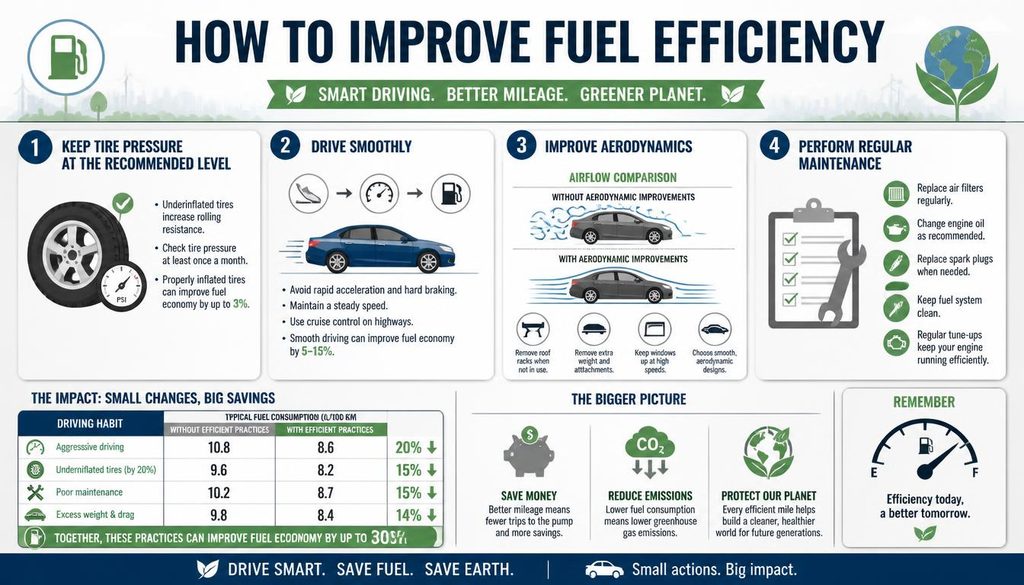
Improving Fuel Efficiency doesn’t always require buying another vehicle. Everyday habits can make a difference.
Keep tires properly inflated, avoid unnecessary aggressive acceleration, remove unnecessary heavy cargo, and maintain the vehicle according to the manufacturer’s recommendations. Combining errands can also reduce repeated cold starts and short trips.
If you regularly drive long distances, maintaining a steady speed and avoiding unnecessary rapid acceleration can help reduce Fuel Consumption.
It is also worth tracking your MPG over time. One tank is only one story. Ten tanks begin to tell you the personality of the vehicle, which is oddly more interesting than it sounds.
Fuel Economy, Regulations, and Vehicle Testing
Modern vehicles are influenced by Fuel-Economy Regulations and efficiency standards established by governments and regulatory bodies. These standards encourage manufacturers to reduce fuel consumption and improve vehicle efficiency.
Official test figures provide a standardized reference, but they cannot reproduce every driver’s circumstances. Your commute, climate, traffic, road surface, cargo, and driving style all create a different operating environment.
That is why EPA Fuel Economy figures should be treated as comparison information rather than a guarantee of your personal MPG.
How to Use a Gas Mileage Calculator Correctly
For reliable results, gather the best data you can.
Record the odometer or trip distance, note the amount of fuel purchased, and keep the Fuel Price from your receipt. If possible, refill under similar conditions and track multiple tanks.
Then enter:
- Total Distance
- Fuel Used
- Fuel Price
- MPG or expected Fuel Economy
- Fuel Tank capacity, if calculating range
The more consistent your information, the more useful your results become.
A calculator can’t repair bad input. If you accidentally enter kilometers as miles or Imperial gallons as US gallons, the result may look precise while being completely off. Numbers can be very confident little creatures.
How to Write Down Your Own Fuel Log

Keeping a simple fuel log is one of the easiest ways to understand your car.
Each time you refuel, record the date, odometer reading, gallons or liters purchased, fuel price, and total cost. After several entries, calculate the average.
You can also record whether the driving was mostly highway, city, mixed, or unusually demanding. Over time, you’ll start seeing patterns.
Perhaps your summer highway MPG is strong while winter city driving is lower. Maybe carrying rooftop cargo changes the result. Maybe a tire-pressure issue caused an unexpected drop.
That information is more useful than one isolated dashboard number.
A Little Fuel-Economy Wisdom for Families
Welcoming a baby girl often changes the rhythm of everyday life. A trip that once took twenty minutes may suddenly involve bags, blankets, bottles, extra stops, and a tiny passenger whose schedule is more mysterious than any GPS route.
Planning fuel costs can remove one small uncertainty from those journeys. Parents can estimate fuel for visits to relatives,
pediatric appointments, weekend drives, or longer family holidays. Grandparents can do the same when traveling to meet their newest family member.
Across cultures, the arrival of a daughter is often marked with gatherings, meals, prayers, gifts, photographs, and visits from relatives. The details vary widely, but the common idea is beautifully simple: people make time for someone new.
And perhaps that is why practical planning matters too. The emotional moments are precious, but the journey to reach them still needs fuel.
Practical Ways to Personalize Your Fuel Calculations
If you’re using a gas cost calculator for a specific trip, don’t stop at the basic fuel estimate.
Add a realistic buffer for traffic, weather, detours, and driving conditions. Check fuel prices along your route and identify convenient Fuel Stops before leaving. If your journey crosses countries or regions, verify whether the stated MPG uses a US or Imperial gallon.
For family trips, include the extra distance caused by planned stops. For work driving, track business mileage separately.
For delivery driving, calculate fuel cost against income. For a new vehicle, compare estimated annual fuel expenses instead of looking only at advertised MPG.
The goal isn’t to make driving feel like accounting. It is simply to make the numbers visible enough that they can help you make sensible plans.
Frequently Asked Questions
gas mileage calculator
A gas mileage calculator helps you determine your vehicle’s fuel efficiency based on miles driven and fuel used.
mpg calculator
An MPG calculator calculates miles per gallon by comparing the distance traveled with the amount of fuel consumed.
how many miles per gallon of gas
Miles per gallon (MPG) tells you how many miles your vehicle can travel using one gallon of gasoline. Higher MPG means better fuel efficiency.
how much gas is used per mile
Gas used per mile can be calculated by dividing the amount of fuel consumed by the miles driven. This shows your vehicle’s fuel consumption rate.
how to calculate mpg
To calculate MPG, divide the number of miles driven by the gallons of gas used. The formula is MPG = Miles Driven ÷ Gallons Used.
Read This Blog:https://wevorix.com/grade-calculator/
Final Thoughts on Using a Gas Mileage Calculator
A Gas Mileage Calculator is a small tool with surprisingly broad usefulness. It can help you calculate MPG, estimate Fuel Needed, determine Trip Cost, compare fuel economy, understand Real-World MPG, and build a practical fuel budget.
The core formulas are simple:
MPG = distance / fuel
Distance = MPG × fuel
Fuel = distance / MPG
Trip Cost = (distance / MPG) × price
Cost Per Mile = price per gallon / MPG
And the important conversions are just as handy:
1 mile = 1.609344 kilometers
1 US gallon = 3.78541 liters
1 Imperial gallon = 4.54609 liters
25 MPG ≈ 10.63 km/L
25 MPG ≈ 9.41 L/100km
The real value comes from using these calculations with real information from your own driving. Your odometer, fuel receipts, tire pressure, weather, routes, and driving habits all tell part of the story.
And just like preparing for the arrival of a baby girl, good planning doesn’t remove the surprises from the journey. It simply means you’re a little more ready for them.
Whether you’re heading across town, starting a new family tradition, managing a delivery route, or setting off on a long Road Trip, understanding your vehicle’s fuel use can make the journey feel more predictable.
If you’ve ever discovered that your car’s actual MPG is very different from its advertised number, or you’ve found a clever way to save fuel during road trips, share your experience.
Sometimes the most useful fuel saving advice isn’t hiding in a specification sheet at all; it’s sitting in someone’s everyday experience, waiting to be passed along.
